Confidential Email Disclaimer: A Guide for Businesses
A confidential email disclaimer can support handling expectations, but it is not a legal shield by itself. This guide explains when disclaimers help, when they add noise, and how businesses should write and apply them responsibly.

Most advice on a confidential email disclaimer starts with a template. That's backwards.
A footer doesn't become powerful because it sounds legal. It becomes useful when it supports a confidentiality obligation that already exists, fits the message it's attached to, and gives the recipient a clear instruction. Otherwise it's boilerplate pasted onto everything from board papers to webinar invites.
The question worth asking isn't which disclaimer to copy. It's when the notice reduces risk and when it's just noise; that line is what separates a working compliance process from a ritual.
That disclaimer is probably not doing what you think
Plenty of organizations treat a confidential email disclaimer as a legal shield. It isn't one.
The footer can help show intent. It signals that the sender treated the message as sensitive and gave instructions for the wrong recipient. That has value in a dispute. It does not do the primary legal work on its own.
The practical limits are easy to miss. A disclaimer does not recall a misdirected email, prevent a screenshot, convert ordinary business information into protected material, or repair weak internal handling. If a sales rep sends pricing to the wrong prospect, the failure is the send. If someone drops a roadmap into the wrong thread, the questions will be who had access, which policies applied, and whether the business used reasonable controls before the message left.
Practical rule: a confidential email disclaimer works best as supporting evidence of intent, not as the primary legal mechanism.
The same pattern shows up in growing companies over and over. Legal asks for a standard disclaimer on outbound mail; operations adds it globally; marketing assumes the risk is now covered because the language looks formal. That's where teams get into trouble.
The controls that matter sit elsewhere. Contracts define duties, access controls limit exposure, encryption protects the message in transit, and training reduces careless forwarding. Channel choice matters too, since some conversations shouldn't happen over ordinary email at all.
What a confidential email disclaimer is
A confidential email disclaimer is a short notice in the footer or signature block saying the message may contain confidential, privileged, or restricted information, and telling an unintended recipient what to do about it.
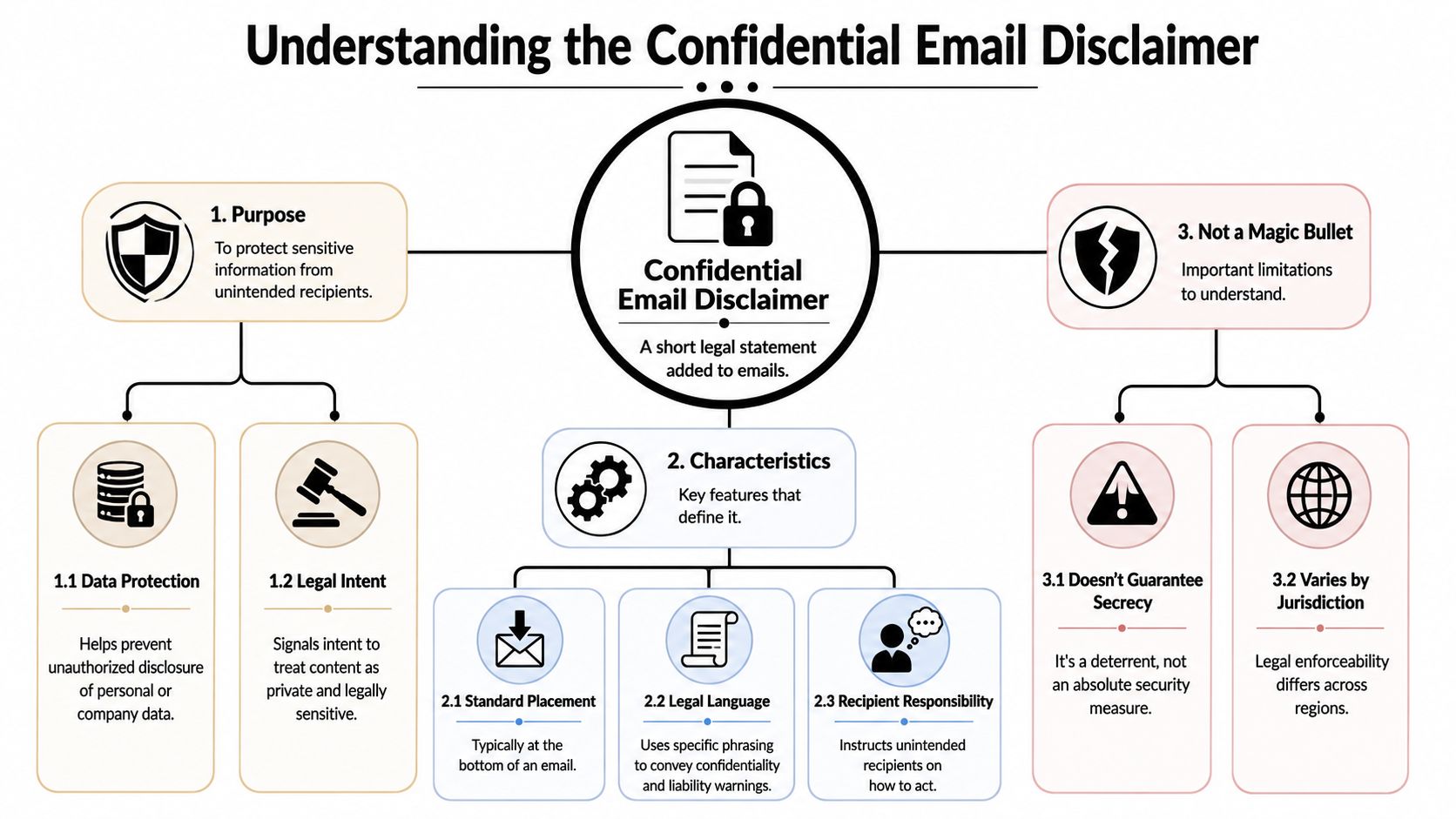
It does three things. It gives notice that the contents need care. It sets expectations by telling recipients that copying or forwarding falls outside the sender's intended use. And it provides cleanup instructions: notify the sender, delete the message, don't use or disclose it further.
That's simple because it is simple. The mistake is assuming the footer does more.
A disclaimer works like a "Fragile" sticker on a package. It signals how the contents should be handled and may help show intent later; it doesn't stop mishandling, and it doesn't turn ordinary information into protected information by itself.
Short, readable language outperforms a long block of threats. A recipient who understands the instruction in one pass is more likely to follow it. A footer nobody reads adds clutter and nothing else.
The same principle applies in marketing operations, where a footer clarifies handling expectations but does nothing about consent rules, suppression processes, or sender identification. Promotional sends need CAN-SPAM compliance and the wider set of email marketing laws handled properly; no confidentiality notice substitutes for either.
Enforceability turns on duties you already had
The honest answer is unsatisfying: sometimes, in context, and never on its own.
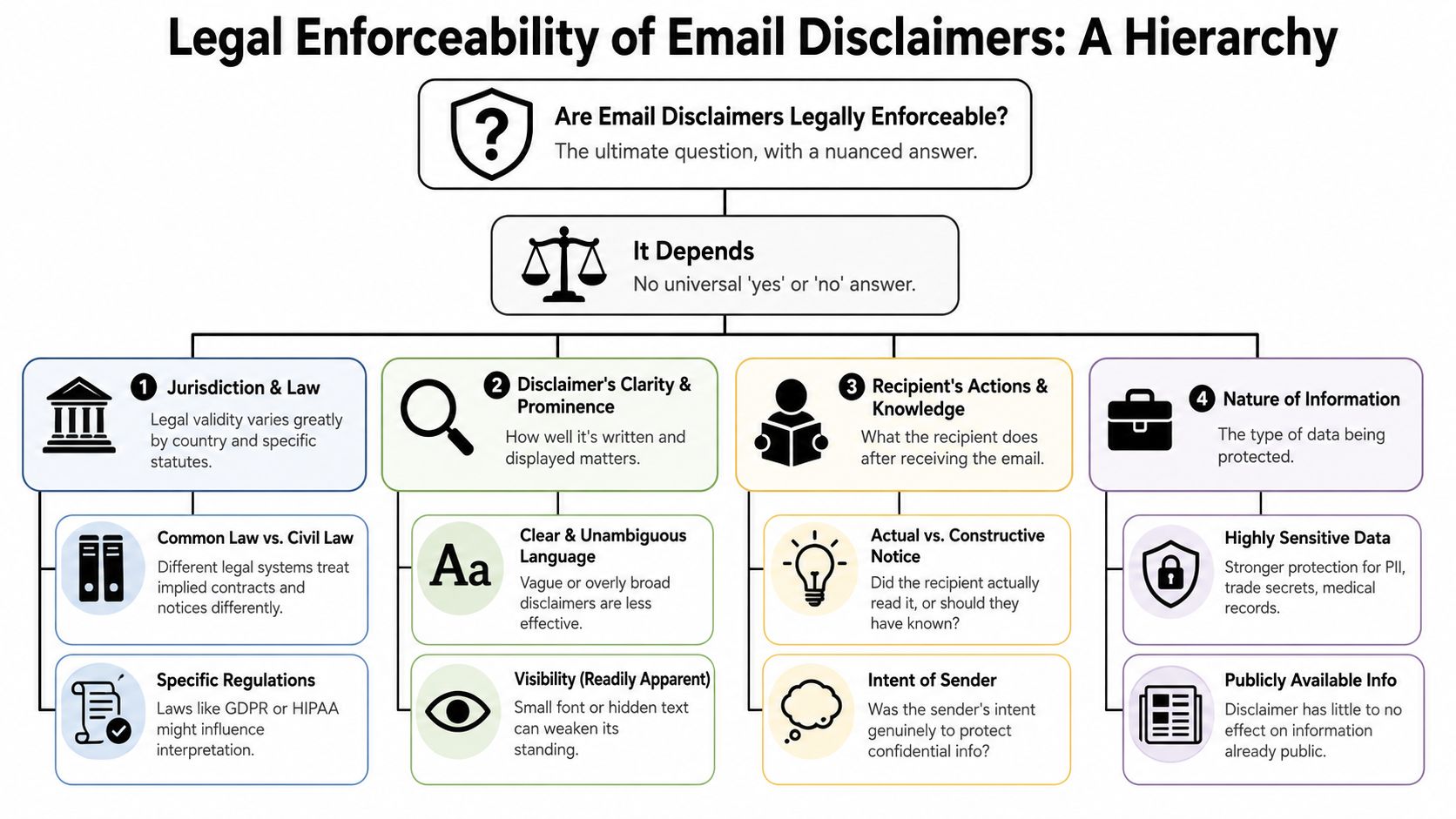
No general law in the US or EU requires a confidentiality footer on ordinary business email. Some regulated professions and sectors have their own notice practices, but for most companies the disclaimer is a risk-management choice rather than a legal obligation. What determines your position is whether underlying duties exist through contract, privacy law, professional regulation, or privilege.
That's the point template articles skip. Neutral legal commentary on the subject stresses that courts tend to look to duties arising from contracts or statutes rather than the footer itself, and warns that automatic inclusion on every message erodes recipient attention and the notice's practical effect (analysis of email confidentiality disclaimers and their limits).
If no duty of confidentiality existed before the email was sent, the footer usually won't create one. If the duty already existed, the footer can help show intent and reinforce handling expectations.
The distinction has teeth. A lawyer sending privileged advice stands on firmer ground than a marketer circulating a campaign draft; an agency sharing client strategy under a master services agreement is relying on the contract first and using the disclaimer as reinforcement.
When enforceability becomes a live issue, four questions usually matter more than the wording:
- Was the information already confidential? Trade secrets, privileged communications, and regulated health data have a different profile from ordinary business chatter.
- Was there an existing duty? An NDA, service agreement, employment policy, or statute carries the weight.
- Did the sender behave consistently with confidentiality? If the same information was circulated broadly and stored without access controls, the footer starts to look performative.
- Was the notice readable and specific? A short instruction has a better practical case than a footer so bloated nobody notices it.
This shapes daily behavior, not just litigation. When people believe the disclaimer handles confidentiality, they get careless about channel choice; they send sensitive attachments over ordinary email instead of a secure portal, and they leave boilerplate on automated messages assuming a box has been ticked.
The most dangerous disclaimer is the one that convinces your team a weak process is good enough.
When to actually use one
A confidential email disclaimer earns its place when the message carries real sensitivity and a misdirected send would create genuine business, legal, or regulatory exposure. Good candidates include privileged legal communications, nonpublic financial terms and due diligence material, regulated personal data, client confidential material such as campaign strategy or proprietary research, and internal corporate material like pre-release features, security incident detail, or board papers.
In those cases the footer does practical work. It reinforces the seriousness of the message and tells a mistaken recipient what to do next, on top of the access controls and contracts you should already have.
If your work touches personal data across jurisdictions, the disclaimer sits alongside your privacy posture rather than standing in for it; teams handling regulated customer communication should review their GDPR practices directly.
What shouldn't carry a heavy confidentiality notice: routine newsletters, general sales outreach, appointment reminders, standard lifecycle messages, internal admin chatter, mass promotional campaigns. Those messages don't become safer or more enforceable with a legal footer attached; they just get longer and easier to ignore.
A short internal policy beats universal application. Apply the disclaimer when at least one of these is true:
| Trigger | Why it matters |
|---|---|
| The email contains legally privileged content | The notice supports an already sensitive legal status |
| The message includes regulated or restricted data | The footer reinforces handling instructions |
| The email sits inside a contractual confidentiality relationship | The disclaimer backs up the agreement |
| A mistaken send would cause material harm | The recipient needs immediate action steps |
If none apply, don't force it. Overuse creates disclaimer blindness; once the same warning appears on every invoice receipt and calendar invite, people stop processing it entirely.
How to write one that works
The drafting goal is narrow. Tell the wrong recipient what this message is, who it was meant for, and what to do next. Everything else has to earn its place.
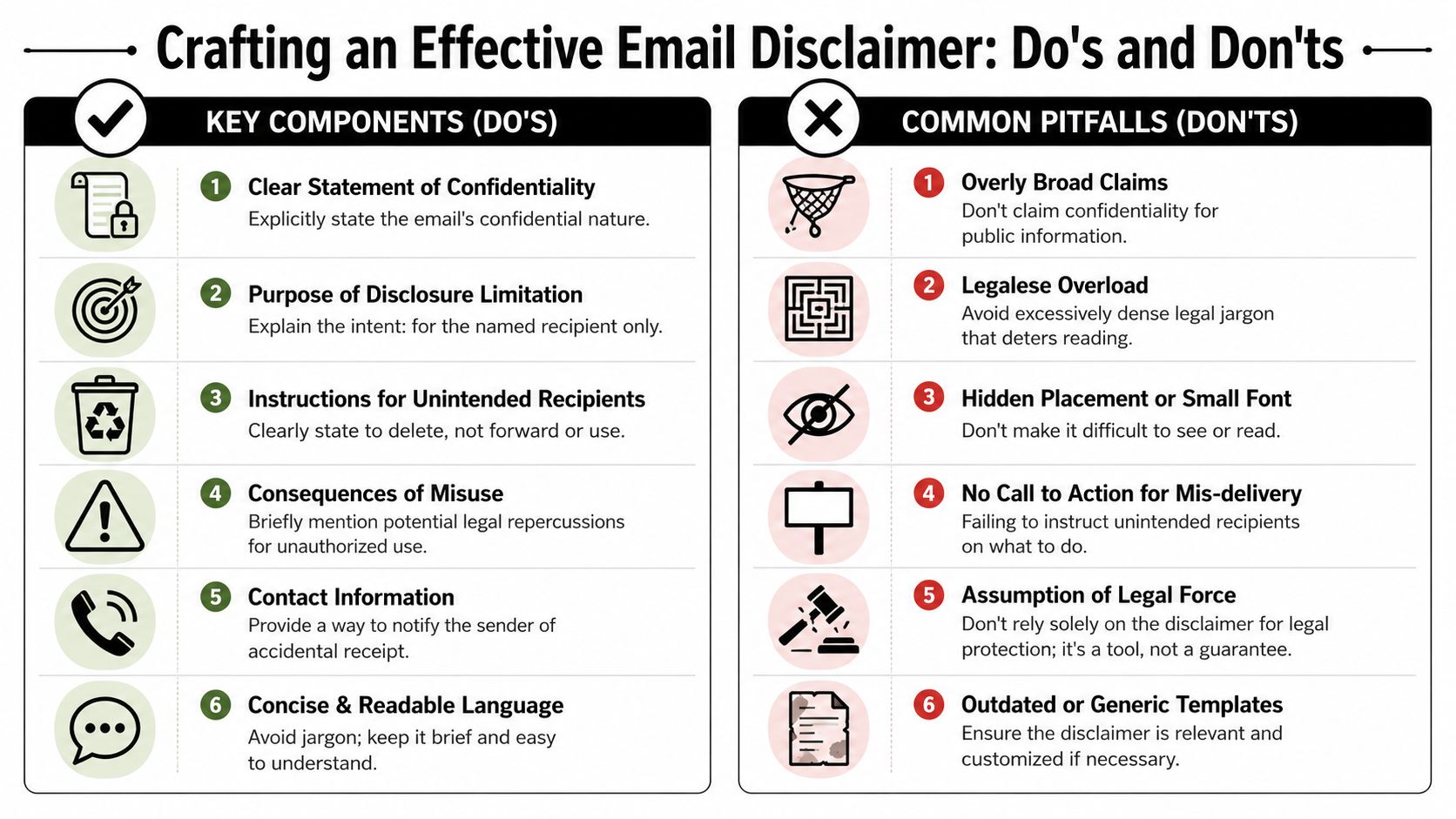
A usable disclaimer states that the email may contain confidential or privileged information, identifies the intended recipient, gives instructions for mistaken delivery, and restricts use, disclosure, copying, and forwarding without authorization. Some businesses add a line clarifying that email exchange alone doesn't form a contract without formal confirmation.
That last one deserves restraint. A contract disclaimer can set expectations in sales or procurement, but weak wording won't override a badly run approval process. If your team negotiates commercial terms by email, fix the workflow as well as the footer.
Here's a clean general version:
This email and any attachments may contain confidential or privileged information and are intended only for the named recipient. If you received this message in error, please notify the sender promptly and delete it. Do not use, disclose, copy, or forward this message without authorization.
Weak disclaimers fail predictably. They run too long, so the recipient skips the wall of text. They claim too much, labeling routine updates as confidential in a way no counterparty would accept. They use legalese where an instruction belongs. And they get treated as a replacement for access limits, review rules, and signed agreements.
A good test: read your disclaimer on a phone. If the first useful instruction arrives after several lines of dense copy, cut it down.
The usual placement is the signature block or footer, which keeps the wording consistent instead of relying on staff to paste custom text into sensitive threads; our email signature generator handles that formatting if you're standardizing across accounts.
Then treat the text as a controlled business asset. Review it when you change privacy notices, approval rules, regulated workflows, customer terms, or brand-wide email settings. Folding that review into an email compliance checklist is the simplest way to stop it slipping for three years.
Wording that fits your business
One general template covers most sends. Where it's worth diverging is the confidentiality clause itself, because naming the category of information makes the notice more credible than a generic claim over everything.
An ecommerce operator should name customer and transaction sensitivity: order details, account information, commercial terms. Reserve it for support escalations, finance exchanges, vendor negotiations, and internal customer reviews rather than marketing mail.
A SaaS company's biggest drafting mistake is vagueness. If your team routinely emails beta plans, architecture notes, security discussions, or enterprise pricing, say those words. Specificity is what makes it credible later.
An agency has a genuinely different problem: a single thread often contains client-owned confidentiality and agency-owned proprietary process at the same time, with contractors and client stakeholders both on the cc line. The wording should acknowledge both, because the two obligations come from different agreements and can be enforced by different parties.
If your disclaimer could sit under any email from any company in any industry, it's probably too generic to carry much weight.
What to do when you receive one
The risk of ignoring a disclaimer on inbound mail depends on what the message contains and whether separate duties apply to you. If it involves privileged, contractually protected, or otherwise sensitive material, ignoring the notice can increase your exposure. The footer isn't the whole legal story; it does make it harder to argue you had no warning.
The practical response is short. Don't forward it, tell the sender, delete it, and don't act on what you read. That costs you nothing and closes off the argument entirely.
One rule matters more than any wording choice. If a message would create serious exposure when misdirected, don't lean on the disclaimer as the safeguard. Confirm the recipients, limit access to attachments, check the send list, and train staff on escalation. That's where the risk actually drops.
If your team sends a mix of campaigns, customer journeys, and sensitive operational email, you need more than a template library. Mailneo helps businesses build email systems that stay usable for marketers while supporting the controls compliance teams care about.
Explore: Email Compliance
Related Articles
Mailneo Is CASA Tier 2 Certified. It Took Us Two Attempts.
Google makes every app that touches restricted Gmail scopes pass an independent security assessment. Ours came through on 31 July 2026. What CASA actually checks, why our first attempt never happened, what the lab found when they scanned us, and what any of it changes for you.
Email Marketing Laws: A Practical Compliance Guide
What CAN-SPAM, GDPR, PECR, and CASL actually require of a marketing team, turned into consent capture, source vetting, suppression, and a pre-send checklist you'll use.
Suppression List Management: How to Stop Bad Sends
Suppression list management is the process of preventing emails from going to people who bounced, complained, unsubscribed, or should not be contacted for compliance reasons. A good suppression system protects deliverability, preserves consent records, and stops old imports from reactivating addresses by mistake.
CAN-SPAM Compliance: The 2026 Guide for US Email Marketers
The CAN-SPAM Act sets seven rules for commercial email sent to US recipients, from accurate headers to a working opt-out honored within 10 business days. This post is general information, not legal advice; the FTC can fine you up to $51,744 per offending email.
Ready to supercharge your email marketing?
Start sending smarter emails with AI-powered campaigns. No credit card required.
Get Started Free