What Is 3rd Party Data? A Practical Guide for 2026
Third-party data is information you buy or license from a company that never collected it from you directly. Here's how the market actually works, where outside data still helps a small team, why the consent chain is the real risk, and the questions that separate a serious vendor from a polished spreadsheet.

Third-party data is information you buy or license from a company that never had a direct relationship with you or with the people in the file. Someone else collected it, someone else combined it, and you are buying access to the result. That's the whole definition; everything after it is a question of where the records came from and whether your intended use matches the permission behind them.
The category gets written off more often than it gets understood. Third-party cookies have been dying in public for years, so people assume the data went with them. Cookies were only ever one collection mechanism. Public records, survey panels, subscription registrations, point-of-sale feeds, warranty cards, and app SDKs all still produce sellable data with no cookie anywhere in the chain. Activation across the open web got harder; supply did not disappear.
Here's the analogy I keep coming back to. Your first-party data is a notebook you kept yourself, where you watched every entry happen. Third-party data is a town directory somebody else compiled and then sold to you. The directory is genuinely useful when you need to reach people who have never heard of your brand. You just didn't witness how any given line got in there.
How a person becomes a segment you can buy
Raw signals are almost never sold one row at a time. A publisher, retailer, survey firm, or public agency captures something; an aggregator merges that stream with a dozen others; attributes get inferred and appended (this is where labels like "homeowner" or "in-market for a truck" show up, and inference is doing a lot of quiet work); the result gets packaged as a named audience; then a marketplace or ad platform sells you activation.
Five hops, minimum. Each one puts distance between a real person and the segment sitting in your campaign manager.
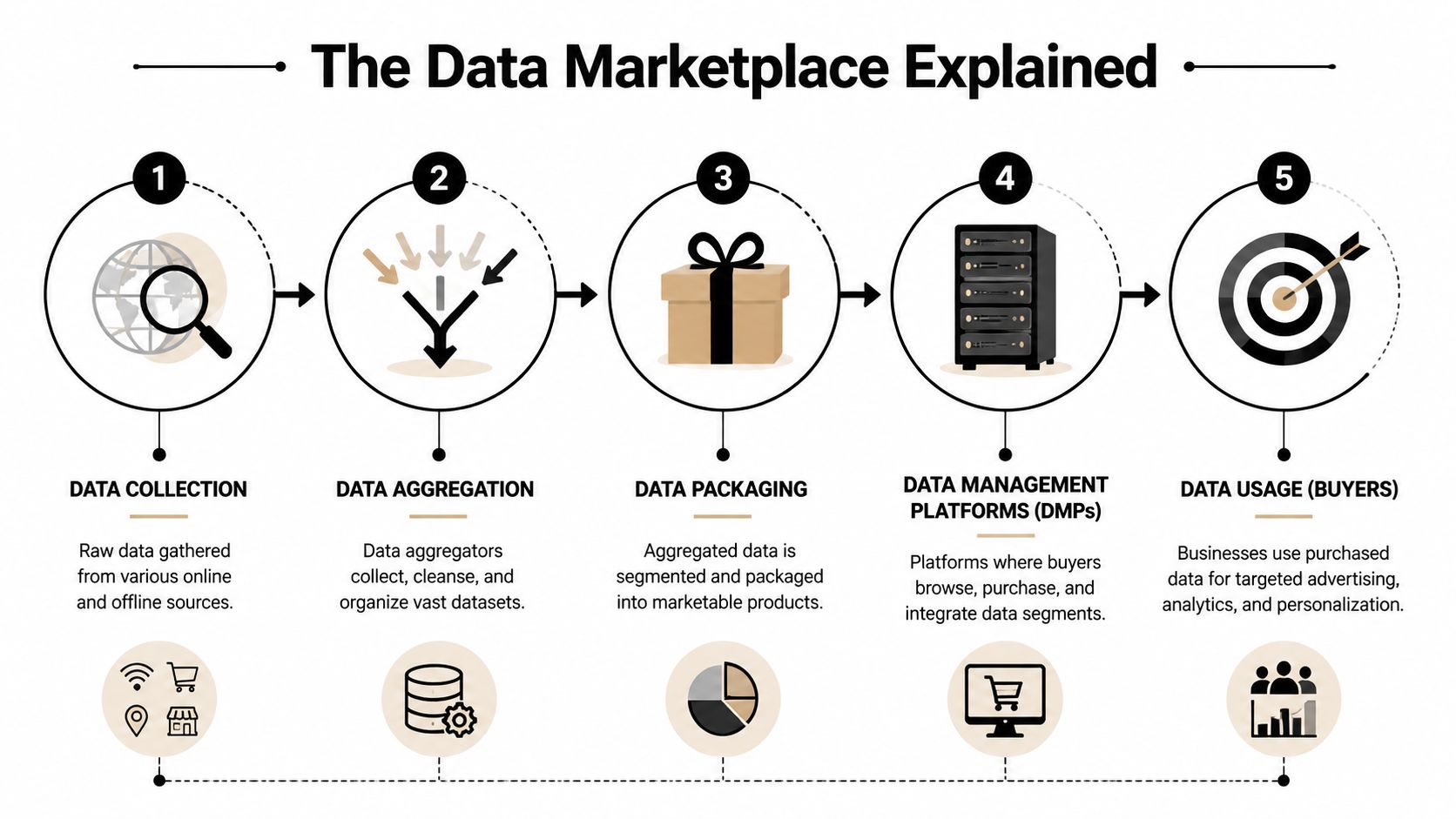
That distance explains why the market feels opaque even when everyone involved is behaving well. A vendor with a clean website may be reselling four upstream suppliers it has never audited, so the "source" turns out to be a chain rather than a place.
| Player | What they do | What to ask them |
|---|---|---|
| Collector | Captures the original record | Was the notice specific about resale? |
| Aggregator | Merges many inputs into one profile | Which fields are declared and which are modeled? |
| Broker or marketplace | Packages and resells segments | Who are the upstream providers? |
| Platform | Activates the data in campaigns | Can we see metadata and usage limits per field? |
Treat these companies like ingredient suppliers. A software subscription you judge on features; a supplier you judge on what's in the crate.
Where outside data earns its keep
Three jobs, and outside data is decent at all of them: finding people beyond your house list, adding context to records you already hold, and sizing a market you haven't entered yet.
For a small ecommerce brand the job is reach. Your own list tells you who already bought; it can't tell you who else looks like them. Household-level audience data gives you a coarse prospecting layer to test on Meta, Google, retail media, or a postcard drop. Keep the segments broad (category interest, region, price band) because granular personal traits are where inference error concentrates, and judge the buy on what a customer ended up costing rather than on the vendor's match rate. The customer acquisition cost calculator settles that argument faster than any deck. Once somebody actually buys, the outside data stops mattering and your owned ecommerce lifecycle flows take over.
B2B is a different job: enrichment. You know who started a trial. You don't know their headcount, their stack, or whether the person who signed up can sign a contract (usually they can't). Firmographic appends let sales prioritize by something better than who opened an email. Just check whatever the vendor claims about your category against published industry benchmarks before you accept it as your baseline.
The consent chain is where it breaks
The legal problem here is operational rather than philosophical. You're processing personal data that somebody else collected under a notice you never read, about people who have no idea you exist.
Under GDPR that gap comes with a specific obligation. Article 14 says that when you obtain personal data from a source other than the person themselves, you have to tell them, including where it came from, generally within a month. Most buyers of third-party data skip this quietly. (I have never once seen a small business send that notice.) The California framing differs, but the direction of travel is the same: the resale chain is being pushed to document itself, and the state maintains a public register of data brokers you can check a vendor against.
So the three questions that matter before money moves are whether the person was told their data could be sold, whether the vendor can actually evidence that, and whether your planned use fits the purpose the data was collected for. Get audit rights, deletion obligations, and breach notification into the contract while you still have leverage; buying data does not move responsibility off your desk, it just adds a layer you now have to supervise.
Emailing addresses you bought is the version of this that goes wrong fastest. People who never opted in hit the spam button, and mailbox providers will price that behavior into your sender reputation for months afterward. If you ever append addresses to a live list, watch your spam complaint rate and bounce rate daily for the first few sends, and read the deliverability guide before the first one goes out. Our GDPR email marketing guide covers the consent side properly; the short version is that a vendor's assurance isn't consent you can lean on.
What to ask before you pay
Cheap bad data is expensive. Premium bad data is still bad data.
Third-party files are stitched together from sources that rarely validate in real time, so records go stale, modeled attributes get quoted as facts, and identity resolution quietly mismatches people with similar names at similar addresses. Ask for evidence rather than a demo:
- Where does this originate? "Proprietary network" is not an answer; source categories are.
- Which fields are declared by the person, and which ones did you model?
- How often does the file refresh, and what triggers a refresh?
- How do you resolve identity when two sources disagree about the same record?
- Which fields should we never use for personalization?
- Can we test a sample against our own customer data before signing anything?
That last one does most of the work. Overlay a few hundred sample records on customers you already know cold (any vendor who refuses a sample has answered the question anyway), then count how many the file got wrong; if it fumbles the people you can verify, the strangers are worse.
One more question, and it's the one vendors like least: how do you make money? Some "independent" data and ranking providers take placement or inclusion fees from the suppliers they cover, which bends what you see before you've looked at a single field.
If what you're buying is specifically contact data for outreach, the same evaluation muscle applies to B2B mailing lists, in roughly that order: source, freshness, fit, permission.
Build the mix you actually own
My position, plainly: outside data belongs at the top of the funnel and nowhere else. It's a hypothesis generator. Your own customer interactions confirm or reject what the vendor claimed, and the confirmed part quietly becomes first-party data you never have to rent again.
| Data type | Where it comes from | Best use | Why it beats a purchased file |
|---|---|---|---|
| First-party | Your site, CRM, orders, product usage | Retention, segmentation, lifecycle | You watched it happen |
| Zero-party | Preferences people hand you deliberately | Personalization, onboarding, recommendations | It states intent instead of inferring it |
| Second-party | A partner's first-party data, shared by agreement | Co-marketing, audience expansion | The chain is one link long |
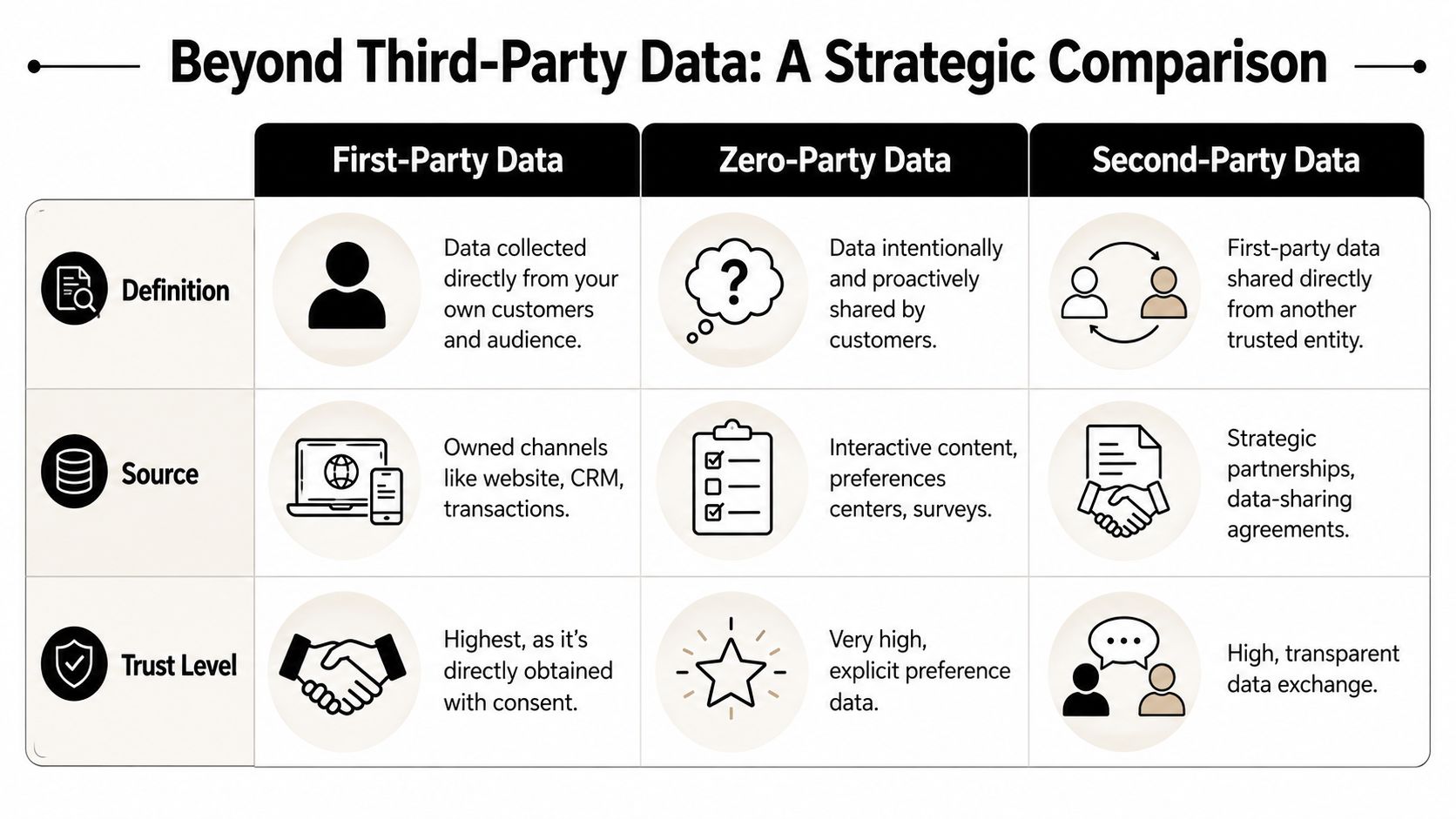
Most small businesses can improve their position here without launching a data transformation project. Deduplicate the CRM and connect purchase history to campaign behavior; you almost certainly hold more than you think, scattered across email, support, and billing systems that were never properly introduced to each other. Add a preference center so subscribers can just tell you what they want. Ask two or three qualifying questions during onboarding, while people are still in a mood to answer. Run co-marketing with one aligned partner under a written agreement that spells out what each side may do with the shared records, and keep the first one narrow.
Then put the result to work. Segmenting the list you own will out-earn any purchased audience, and watching your list growth rate tells you whether the owned side is compounding or leaking.
Third-party data isn't going away, and it deserves neither the panic nor the reverence it gets. Buy it the way you'd buy anything else that goes into a product with your name on it: inspect the source, test a sample, limit the first use case, measure what it did, renew only if it earned the renewal.
If you'd rather grow an audience you own than keep renting one, Mailneo helps small teams run campaigns and automations off their own customer data without a complicated stack.
Explore: Email Marketing Strategy
Related Articles
Business to Business Mailing Lists: A 2026 Guide
Business to business mailing lists are revenue datasets, not static rosters. This guide explains when to build, buy, or enrich B2B lists, how to vet vendors, and how to keep data clean, compliant, and useful for campaigns.
GDPR Email Marketing: What You Need to Know in 2026
GDPR email marketing requires freely given, specific, informed, and unambiguous consent from EU and UK residents before you send commercial email. This is general information, not legal advice; consult counsel for your specific case. Fines reach 20 million euros or 4% of global turnover.
How to segment your email list for better results
Email segmentation splits your subscriber list into smaller groups based on behavior, demographics, or lifecycle stage so every campaign feels specific instead of generic. Mailchimp's segmented campaigns see roughly 14% higher open rates than non-segmented ones; done right, segmentation is the most impactful thing most senders can do this quarter.
Advanced Customer Segmentation for Email Growth
Advanced customer segmentation turns broad email lists into clear action groups based on behavior, value, intent, lifecycle stage, and consent. This guide shows how to build useful segments, connect them to campaigns, protect deliverability, and measure whether segmentation is actually increasing revenue.
Ready to supercharge your email marketing?
Start sending smarter emails with AI-powered campaigns. No credit card required.
Get Started Free