Business to Business Mailing Lists: A 2026 Guide
Business to business mailing lists are revenue datasets, not static rosters. This guide explains when to build, buy, or enrich B2B lists, how to vet vendors, and how to keep data clean, compliant, and useful for campaigns.

Most teams treat business to business mailing lists as a sourcing problem. It is really a capital allocation problem, and that misframing is why so much list spend never becomes pipeline.
A B2B mailing list isn't a file of names; it's a revenue asset with carrying costs, compliance exposure, and very different payback depending on whether you build, buy, or enrich it. Managers who treat lists like inventory usually overpay for volume. Managers who treat lists like a system get better segmentation, cleaner data, and far fewer deliverability surprises six months later.
What a B2B mailing list is in 2026
A usable record includes an email address, a company, a role, and clear source context. The stronger records also carry the signals a team can act on: account status, product fit, geography, buying stage, suppression status, and the last meaningful touchpoint. Without that context a big list creates activity; it does not reliably create pipeline.
Records are also fragile in a way spreadsheets hide. One careless import, one weak vendor, or one missed suppression step can cost you inbox placement inside a week, and sales, marketing, and RevOps all touch the data, so all three can cause it.
A large list gives you optionality. A qualified list gives you pipeline.
Underperforming email programs usually miss for a simpler reason than weak copy: the audience was assembled with the wrong logic for the motion. New-logo outbound needs different records than webinar follow-up. Account expansion needs different fields than channel recruitment. Event activation needs speed; nurture needs cleaner consent history and tighter segmentation.
So stop treating "the list" as one thing. Build when you need trust and first-party intent. Buy when speed and market coverage matter more than depth of context. Enrich when your owned data already contains demand signals and the missing piece is accuracy rather than volume. A list built through interactive lead capture starts with stronger intent signals than anything you can purchase; a purchased file adds reach faster but arrives thin.
Build, buy, or enrich
Companies usually ask this the wrong way round. The question isn't "should we buy a list or build one?" It's "what gets us qualified reach for this objective with the lowest waste and the lowest risk?"
A purchased list solves a speed problem. It rarely solves a targeting problem on its own. A first-party list solves an intent problem and rarely solves a scale problem overnight. Enrichment sits between the two, and it's the option teams skip most often even when it's cheapest; half-complete owned data is frequently one append away from being campaign-ready.
Work the arithmetic before the procurement call. Whatever a vendor charges per thousand records, the number that matters is what a qualified conversation ends up costing you, which the customer acquisition cost calculator will make uncomfortably concrete. A file that's broad and fresh is not automatically the best investment when your CRM already holds dormant leads, product users, webinar registrants, and newsletter subscribers who could be enriched and segmented for less.
| Factor | Building (first-party) | Buying (third-party) |
|---|---|---|
| Time to launch | Slower at the start, stronger over time | Faster initial access |
| Audience intent | Usually higher, because contacts chose to engage | Mixed; depends heavily on source quality |
| Compliance comfort | Stronger when consent and source history are documented | Requires stricter vendor review and internal controls |
| Data depth | Starts shallow, improves as contacts interact | May include broader firmographic coverage upfront |
| Deliverability risk | Manageable if collection is disciplined | Higher if records are stale, mismatched, or poorly sourced |
| Upfront effort | Content, forms, CRM flows, follow-up | Procurement, vetting, suppression checks, testing |
| Best use case | Demand capture, lifecycle marketing, newsletters, webinars | New market entry, account list expansion, niche targeting |
| Common failure mode | Weak value exchange leads to slow growth | Paying for volume that never becomes pipeline |
The sequence that keeps teams out of trouble: start from the campaign objective, audit owned data before you shop, estimate what it would cost to clean and enrich what you already have, buy only when speed or coverage genuinely justifies it, and test small before scaling. Never commit a full outbound motion to an unproven data source.
If your lead capture motion is weak, fixing that creates more durable value than another purchased file. That is the less exciting answer and it is usually the right one.
How to build a first-party B2B list
The strongest first-party lists get built the way strong pipelines get built: a clear ideal customer profile, a genuinely useful offer, and a capture path that respects the buyer's time.
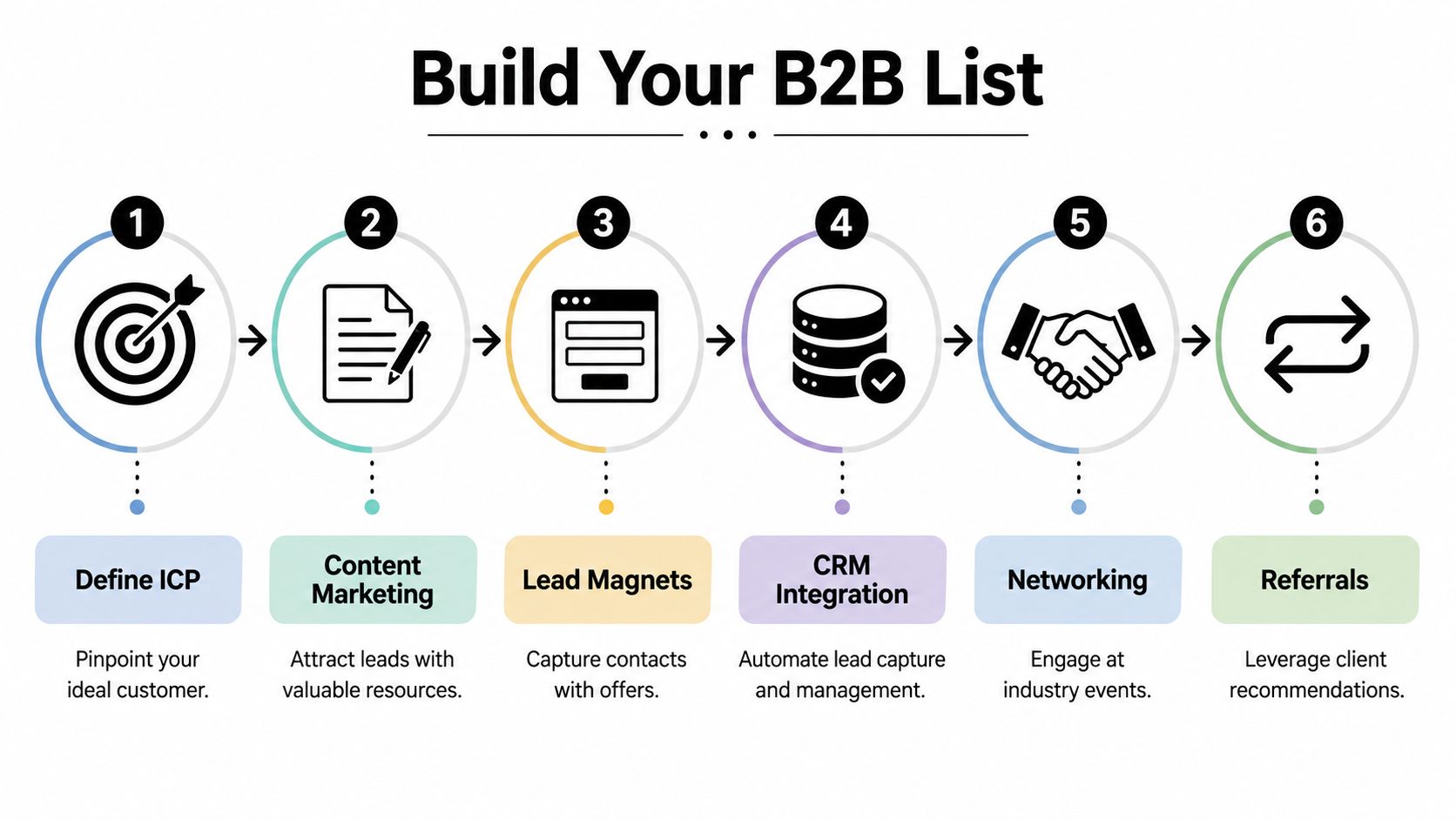
Build around moments when a prospect is already leaning in, which in practice means content with job relevance rather than generic top-of-funnel material. The motions that repeat well are gated resources that solve an immediate work problem (implementation checklists, template packs, industry playbooks), webinars and live demos where registration doubles as an opt-in, LinkedIn-led prospecting through posts and events, co-hosted partner programs, and referral loops from customers who know peers with the same operational pain.
The other half of building is restraint at the form. Asking for job title, company size, stack, phone number, budget, territory, and team structure on first contact doesn't just create friction; it produces low-confidence answers because people rush through long forms and type whatever gets them to the download.
Progressive profiling fixes that. Ask for the minimum needed to start the relationship, validate the address in real time at the point of capture, then learn more through follow-up emails and CRM workflows. Apply double opt-in where it matters, especially in stricter markets, and store source and consent context alongside the record rather than in someone's memory.
The cleanest list-building systems think like product teams. They reduce friction at signup, then improve data quality through later interactions.
Build this way and your list grows slower than a sloppy one. It also stays usable, which is the trade that actually pays.
How to vet a list vendor before you buy
Buying a list isn't reckless. Buying a list without a governance process is.

Every vendor will describe their data as verified, accurate, or premium. Those words carry no information. What matters is whether the provider can explain how records are sourced, refreshed, suppressed, and governed across markets, in operational terms, without reaching for a brochure.
Ask before procurement signs anything: Where does the data come from, specifically? How is freshness maintained, and on what cycle? How are opt-outs, duplicates, and invalid contacts handled on their side before delivery? Which fields are native and which were appended from somewhere else, since that changes how much you should trust them for personalization? How is cross-market compliance handled, and do they understand regional differences or leave all interpretation to you? And what testing process do they recommend, because a serious provider will not push you straight into a full send.
If a vendor can describe quantity faster than governance, keep looking.
A good vendor still won't protect you from your own shortcuts, so the internal process needs its own discipline:
| Checkpoint | What your team should do |
|---|---|
| Before purchase | Define the exact campaign use case and the required fields |
| At contract stage | Require documentation on sourcing, refresh, and suppressions |
| Before import | Map fields carefully and isolate the list from your main database |
| Before send | Validate, deduplicate, and segment into a narrow test group |
| After test | Review engagement, complaints, and fit before expanding usage |
Treat a purchased file as a quarantined dataset rather than a trusted house list, and keep your suppression list centralized so the quarantine can't be bypassed by someone in a hurry. That mindset alone prevents most of the expensive mistakes.
Verification and hygiene
Every mailing list starts decaying the day you create it. People change jobs, companies restructure, inboxes get abandoned, and forms collect junk. Ignore that and deliverability problems arrive before revenue problems do.

The vocabulary is simpler than it sounds. A hard bounce means the address can't receive mail and should come out immediately. A soft bounce is a temporary failure worth watching for repeat behavior. A spam trap is an address that exists specifically to catch poor list practices, and hitting one damages sender reputation in a way that takes weeks to undo. Disposable addresses are created for one-off use and rarely belong in a B2B database at all. Duplicates mostly cause reporting noise and clumsy outreach.
Understanding those categories is easy; building a routine that catches them before they pollute campaign results is the work. Validate at the form level rather than waiting until the campaign is built. Run bulk verification before large sends, especially for dormant segments and imported data. Deduplicate aggressively. Separate inactive from invalid, because someone who hasn't opened lately is a different problem from an undeliverable address. And keep suppression logic centralized so opt-outs never depend on anyone remembering.
Watch bounce rate as your leading indicator here; it moves before placement does. Our email list hygiene guide covers the operational side without turning cleanup into a full-time job.
Clean data protects more than campaign metrics. It protects your sender reputation, your reporting accuracy, and your team's confidence in what the dashboard says.
Segmentation and enrichment
A clean list gets you into the inbox. Segmentation is what makes the message feel relevant once it arrives.
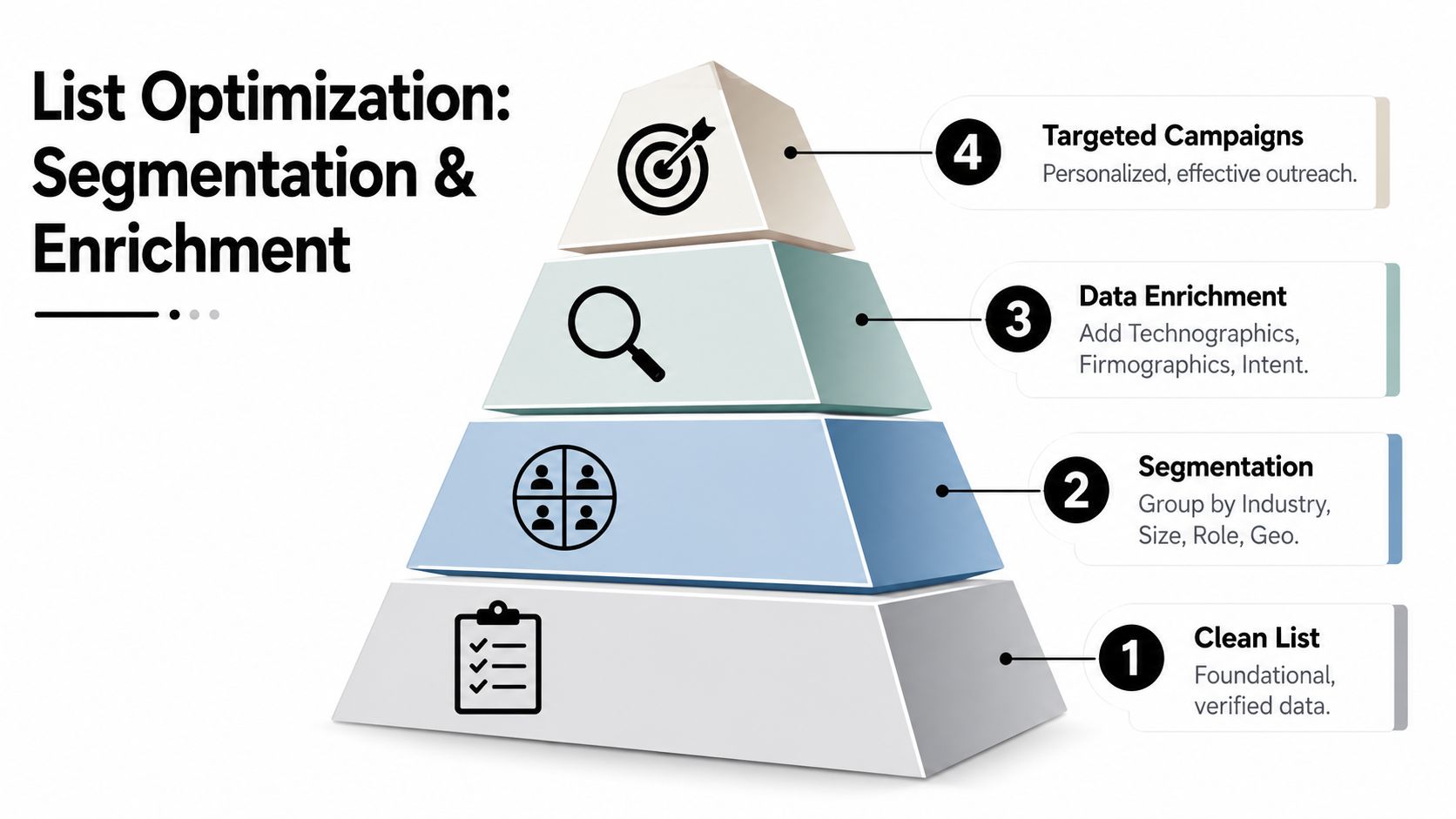
The biggest B2B segmentation mistake is stopping at surface-level filters. Industry, company size, title, and geography matter, but they are the starting point rather than the strategy. Segment for context instead: a CFO cares about cost control and reporting where an operations lead cares about workflow and reliability; a startup buyer and an enterprise buyer may want the same outcome by very different implementation paths; a new lead, a trial user, and a dormant opportunity should never receive the same sequence.
If you want realistic targets to segment against rather than generic averages, the B2B SaaS benchmarks are a better reference point than a vendor's headline numbers, and our guide to email list segmentation covers how to map the slices to actual sends.
Relevance in B2B comes from operational empathy. Show a buyer you understand how their role works and they'll give you more attention.
Enrichment is what turns a thin record into something a team can act on. You append or refine the fields that help with routing, personalization, prioritization, and fit.
| Enrichment type | Why it matters |
|---|---|
| Firmographic data | Tailors messaging by company size, industry, and structure |
| Role data | Improves message angle and call to action |
| Geographic data | Supports regional offers, event targeting, territory alignment |
| Technographic context | Helps position against the current stack |
| Behavioral signals | Makes follow-up sequences timelier |
The best enrichment work is restrained. Add a field because it improves a decision, not because the vendor offers it. A bloated CRM with weak field discipline isn't intelligent; it's just harder to trust.
Metrics and the legal baseline
For B2B email the useful dashboard is smaller than most teams expect. Track what tells you whether the audience was right, the message was relevant, and the list was technically healthy.
Opens are a directional signal at best. Click rate is a much stronger read on message-audience fit, and conversion rate is the only one that speaks to business impact. On the health side, watch bounce rate as a list-quality warning light, unsubscribe rate as a relevance and expectation signal, and complaint trends as the earliest evidence that sourcing or targeting has drifted.
Read them together rather than one at a time. A campaign can post acceptable opens and still fail if clicks and conversions lag; another can look fine on clicks while bounces quietly point back at the data source rather than the creative.
Compliance is the other half, and a footer doesn't solve it. You need a working unsubscribe process, honest sender identification, records of how each contact entered the system, and market-aware handling of consent and suppressions. In the US, the FTC's CAN-SPAM compliance guide sets the baseline; our CAN-SPAM compliance guide for email marketers translates it into campaign operations.
One rule covers most of it. If your sourcing story would be hard to explain to the prospect, to the provider, or to your own counsel, don't send to that record until the story improves.
If your team wants cleaner execution once the strategy work is done, Mailneo is built for exactly that: stronger campaigns, simpler workflows, and a more practical way to turn audience data into sends people actually engage with.
Explore: Email Marketing Strategy
Related Articles
Automatic Lead Generation: A Practical Email Playbook
Automatic lead generation works when you connect clear offers, compliant capture forms, segmented contacts, email automation, and deliverability controls. This guide shows how to build an operational system that attracts, qualifies, nurtures, and converts leads without relying on manual follow-up for every prospect.
Advanced Customer Segmentation for Email Growth
Advanced customer segmentation turns broad email lists into clear action groups based on behavior, value, intent, lifecycle stage, and consent. This guide shows how to build useful segments, connect them to campaigns, protect deliverability, and measure whether segmentation is actually increasing revenue.
Pay Per Lead Marketing: A Complete Guide for 2026
Pay per lead marketing can work when the billable event, validation rules, handoff process, rejection terms, and unit economics are clearly defined. This guide explains how to manage PPL programs without paying for low-quality demand.
Email personalization: beyond "Hi {First Name}"
Email personalization means adapting subject lines, content, offers, and send times to each subscriber using behavioral and lifecycle data, not just merge tags. Personalized campaigns drive 6x higher transaction rates (Experian), and 71% of consumers expect them (McKinsey). Real lift comes from behavior, not first-name swaps.
Ready to supercharge your email marketing?
Start sending smarter emails with AI-powered campaigns. No credit card required.
Get Started Free