Pay Per Lead Marketing: A Complete Guide for 2026
Pay per lead marketing can work when the billable event, validation rules, handoff process, rejection terms, and unit economics are clearly defined. This guide explains how to manage PPL programs without paying for low-quality demand.

"Pay only for results" is the most repeated line in pay per lead marketing, and it's the quickest way to lose money if you take it at face value. Results aren't self-defining. Someone has to decide what counts as a lead, when it becomes billable, how fast it gets validated, whether it's exclusive, and what happens when the contact record turns out to be fake, duplicated, or already sitting in your CRM.
That's where most PPL programs break: in operations, long after everyone stopped arguing about ad creative and channel selection.
A pay per lead deal can genuinely outperform click-based buying or a flat agency retainer, but only when the buyer treats it as a unit economics system. If your sales team can't respond quickly, if your CRM can't dedupe cleanly, or if your contract never defines rejection terms, performance-based pricing just means you're paying for noise in a more convenient format.
What pay per lead marketing means
Pay per lead marketing is a pricing model where a business pays only when a prospect completes a defined action that signals interest. That action might be a form submission, a request for information, a trial signup, or a booked meeting. Instead of buying exposure or traffic, the buyer pays for an inquiry that clears an agreed threshold.
That sounds clean. It usually isn't, because a PPL program is defined by its billable trigger rather than by the label on the invoice.
If a vendor gets paid on every raw form fill, what you have bought is submitted data, and submitted data converts at whatever rate the traffic source happens to produce. A usable agreement spells out three things: which action triggers payment, which data must be present for the record to count (valid phone, working email, service area, requested product line), and what makes a lead invalid, including duplicates, spam, test submissions, and contacts outside your market.
Practical rule: in pay per lead, the commercial model is simple, but the operational definition has to be strict.
PPL shifts risk without removing it. The vendor carries more top-of-funnel risk than under CPM or CPC. The buyer picks up a different one: paying for inquiries that look valid in a spreadsheet and die in a real sales workflow. Profitable programs are built on CRM hygiene, suppression rules, speed-to-lead, and explicit qualification criteria, which is a much less exciting list than the pitch deck offers.
How PPL compares with CPM, CPC, and CPA
The easiest way to compare pricing models is to ask what you're actually buying. CPM buys visibility. CPC buys visits. PPL buys declared interest. CPA buys a completed downstream action such as a sale or a signup. Each pushes risk to a different party and each earns its keep at a different point in the funnel.
A retail analogy holds up well. CPM pays for people walking past your storefront, CPC pays for people stepping inside, PPL pays for people who ask a staff member for help and hand over contact details, and CPA pays only when somebody checks out.
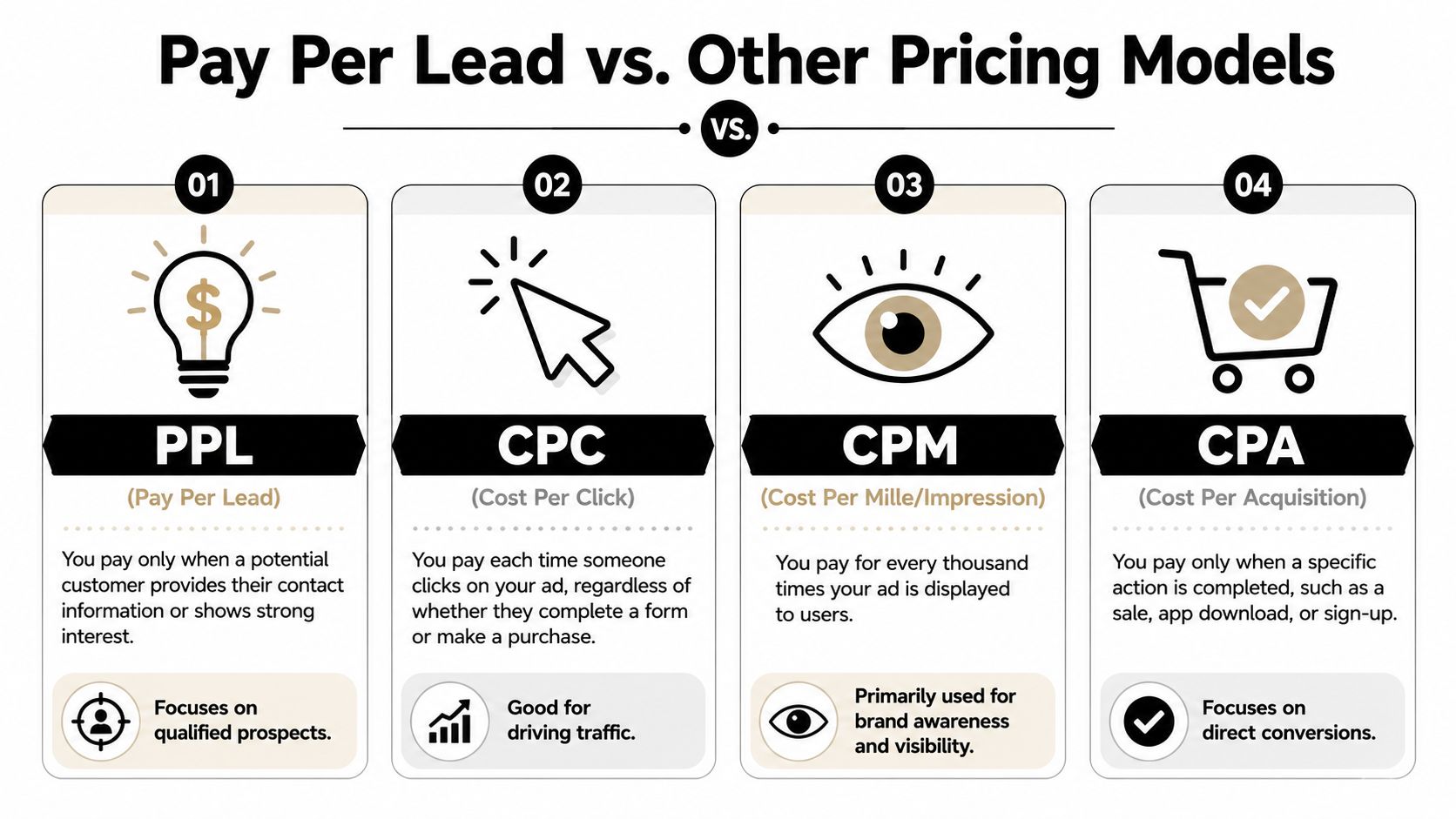
Lead costs vary enormously by company size and channel, which is the real context for any PPL negotiation. Every price gets evaluated against an alternative, so the real question is whether a priced lead beats paying for traffic, reach, or a later-stage conversion in your specific market.
| Model | What you pay for | Best use case | Main upside | Main downside |
|---|---|---|---|---|
| CPM | Ad impressions | Brand awareness, broad reach | Predictable reach buying | Weak signal of intent |
| CPC | Clicks | Traffic generation, landing page testing | Good for testing message-market fit | Clicks can be curious, not qualified |
| PPL | Defined lead action | Service businesses, consultative sales, high-intent demand capture | Clearer link between spend and inquiry volume | Lead quality collapses if rules are loose |
| CPA | Completed acquisition | Mature funnels with strong tracking | Tight alignment to business outcome | Harder to scale, heavier risk for the seller |
The practical takeaways matter more than the table. Use CPM when reach is genuinely the goal, and don't force PPL into an awareness campaign. Use CPC while landing pages still need testing, because click data is useful before lead economics stabilize. Use PPL when sales can work leads fast; a slow handoff destroys most of the model's advantage. Use CPA only once attribution is mature, since messy funnel tracking turns CPA negotiations contentious within a month.
If a vendor pushes PPL as the answer to every growth problem, they're selling a pricing wrapper, not a strategy.
How the handoff actually works
PPL looks straightforward on paper. A prospect submits a form, the lead gets delivered, the buyer pays. In live campaigns there are more moving parts, and more places for quality to leak.
Three actors usually shape the program: the advertiser buying leads, the publisher or lead generator sourcing them, and sometimes a network that brokers delivery and reporting. Traffic gets generated through paid search, social, SEO, email, content, or partner placements. The user takes a defined action. The lead is checked against qualification rules before it becomes billable, pushed into the buyer's workflow by email, webhook, or CRM sync, then accepted or rejected against agreed criteria. Payment reconciles against accepted leads only.
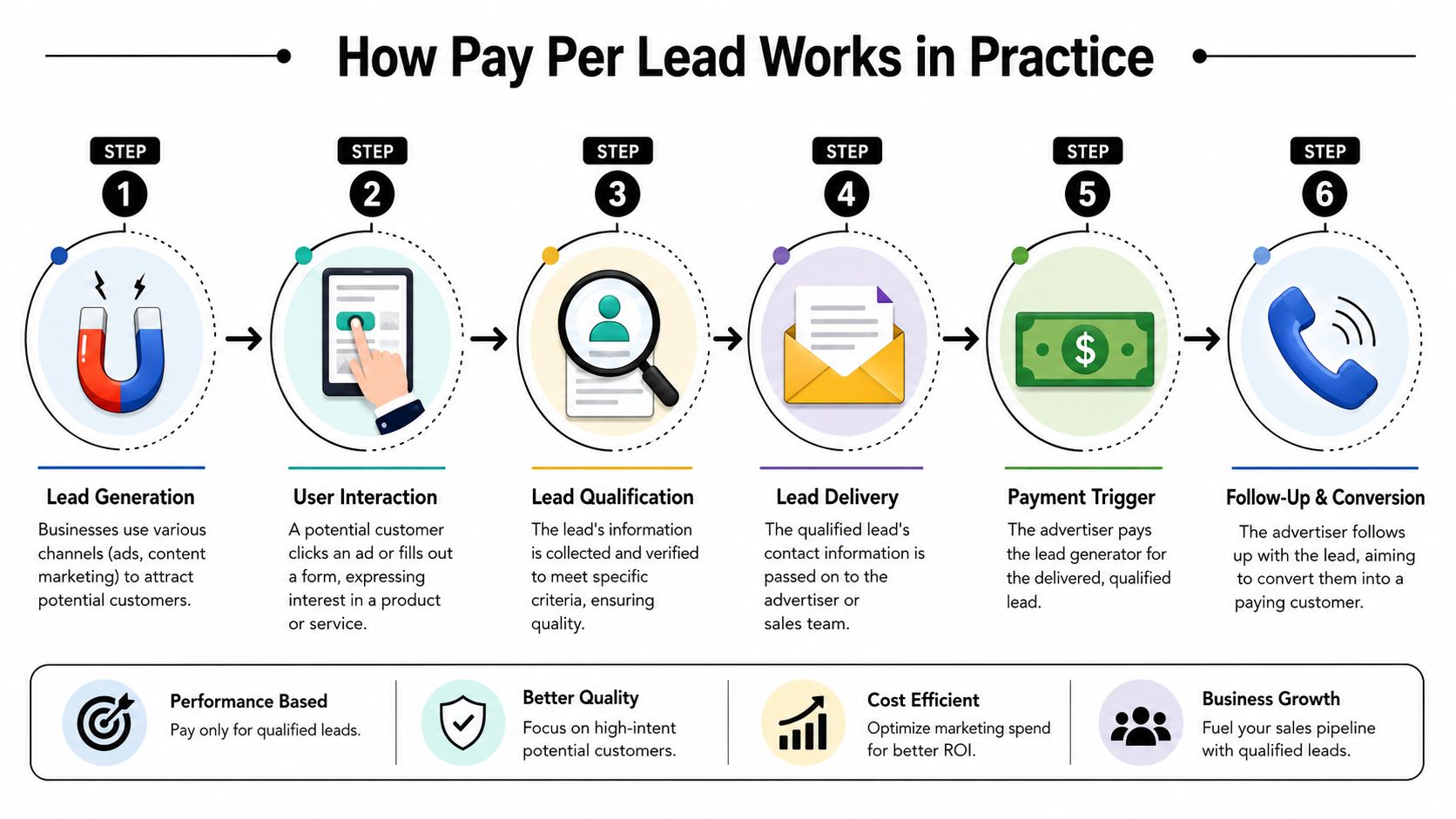
Step three is where teams get stuck. "Qualified lead" sounds specific until somebody asks what it means operationally. Is a Gmail address acceptable? Does a student count for an enterprise software campaign? Is a roofing inquiry valid when the address sits outside the service area? Those answers belong in the contract, not in a Slack argument six weeks later.
The handoff between marketing and sales is where PPL becomes real. Map the lead fields and status rules before launch; a documented intake structure like the lead documentation reference helps a team decide what gets captured, where validation happens, and which statuses trigger downstream action. A solid workflow adds field-level validation for phone, email, geography, and intent data; routing logic so the right rep receives the lead immediately; deduplication against the CRM and recent submissions; and disposition feedback flowing back to the source so quality can improve.
A PPL campaign doesn't fail only because the source is weak. It also fails when the buyer lacks intake discipline.
Experienced operators don't just ask how many leads a vendor will send. They ask what exactly gets submitted, how it's verified, who touches it first, and how quickly a bad record can be rejected.
The metrics that decide whether it works
Cost per lead gets the most attention and, on its own, sends teams in the wrong direction. A low headline CPL creates false confidence; if reps can't contact, qualify, or close the cheap leads, your real acquisition cost rises while the spreadsheet insists the program is efficient.
Lead-stage metrics need context around them. Watch CPL for front-end efficiency, lead conversion rate to see whether sales can turn volume into pipeline, close rate to connect quality to revenue, acceptance and rejection rate to keep the vendor honest, and speed-to-lead, because delayed follow-up destroys value before discovery even starts. The CPL calculator is useful for pressure-testing assumptions before you commit, and customer acquisition cost is the number the program is ultimately judged on.
The formula that sets your ceiling
Your maximum acceptable CPL matters far more than the CPL you happen to be paying today.
Maximum CPL = customer LTV × close rate × lead-to-opportunity rate
That ceiling keeps acquisition cost below expected downstream value, and it changes how you negotiate. It forces three questions that most buyers skip: what a customer is worth over time, how often accepted leads become real opportunities, and how often those opportunities close. If you can't answer the first directionally, you can't set a rational bid on anything.
Weak qualification raises your effective CPL, because low-intent records dilute conversion and shrink what you can rationally pay. Mature teams don't optimize for the cheapest lead; they optimize for the highest lead price they can sustain profitably, which is a very different negotiation.
The risks that show up after launch
The real problems in pay per lead rarely appear in the proposal. They surface later, when reps complain the numbers don't connect, the CRM fills with near-duplicates, and the vendor insists every submission was valid because a form technically got completed.
A common mistake is treating lead quality as the provider's job alone. In practice the buyer has to validate incoming records fast enough to stop bad inventory becoming accepted inventory. A vendor can promise quality; your workflow determines whether you catch the failure in time to reject it.
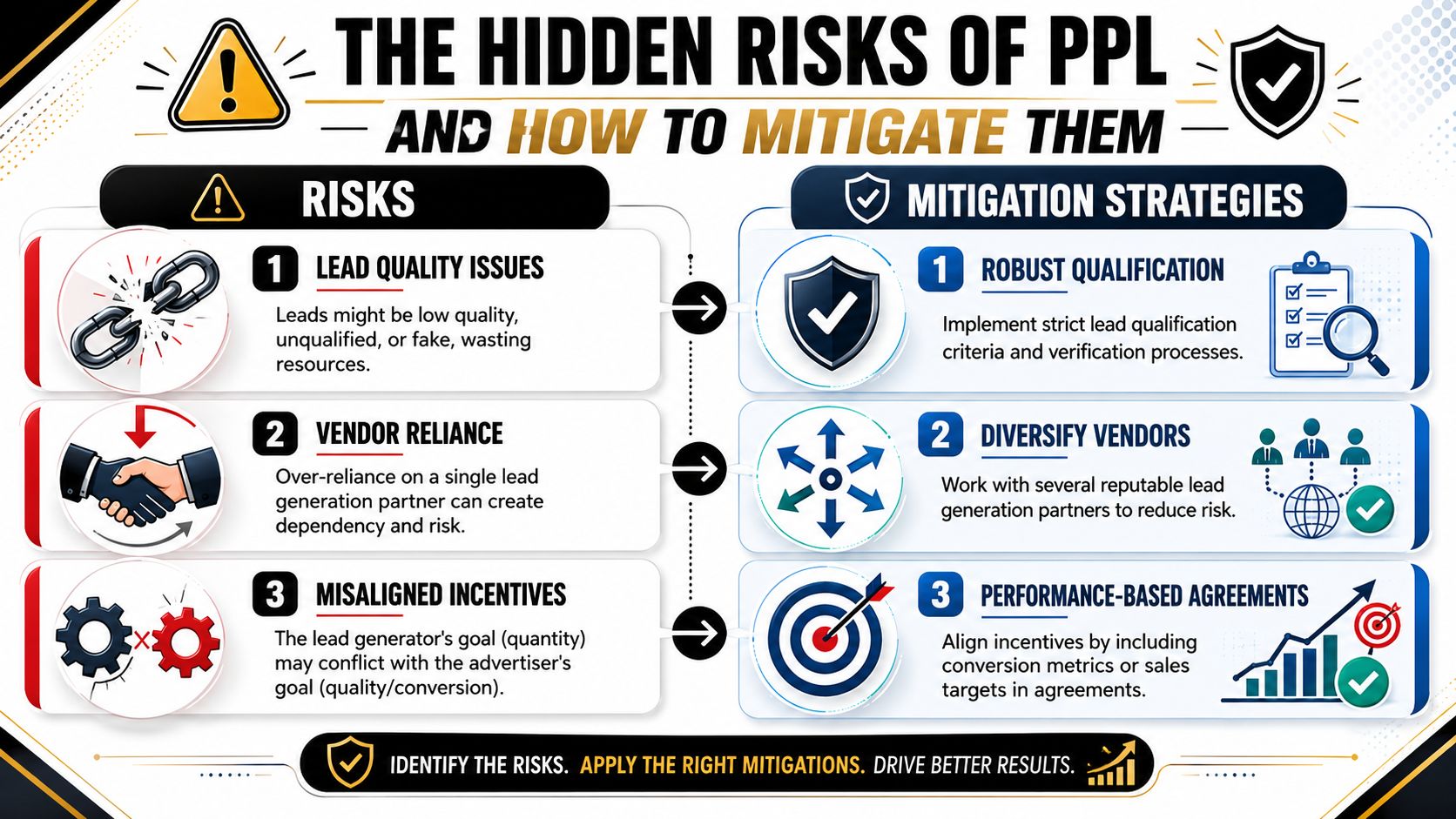
Teams that handle this well run a short validation layer before final acceptance. Syntax checks come first: required fields, email format, phone structure, geography, all on arrival. Duplicate checks come next, against recent submissions, open opportunities, and prior customers. Contactability gets tested inside the acceptance window rather than after it. And suppression logic stays permanently on, blocking existing customers, prior disqualifications, internal tests, and known bad records from re-entering the funnel; suppression list management covers how to keep that list from rotting.
Lead fraud isn't only obvious bots. It shows up as incentivized submissions, fake phone numbers, recycled records, and forms completed with just enough accuracy to survive a surface check.
| Risk | What it looks like | What to do |
|---|---|---|
| Bot or fake submissions | Unnatural form activity, impossible names, unreachable contacts | Honeypot fields, CAPTCHA, field validation, device-level review |
| Duplicate leads | Same person sold twice, minor data variations, repeat submissions | Match on email, phone, address, and recent CRM activity |
| Shared leads | Multiple vendors or competitors contact the same prospect | Define exclusivity terms and rejection rules in contract |
| Stale leads | Delayed delivery, old records, slow routing | Set maximum delivery windows, auto-reject expired submissions |
If exclusivity is undefined, assume the lead is not exclusive.
Most PPL disputes happen because the contract treats quality as a vibe instead of a rule set. Your agreement should define billable lead criteria with exact required fields and accepted sources, a rejection window long enough to actually verify contactability, duplicate logic that spells out what counts as prior ownership in your system, exclusivity terms, delivery standards for timing and format, and audit rights so you can inspect lead logs when quality drops.
Who PPL suits
Pay per lead works best when one conversion is valuable enough to support a disciplined acquisition cost and the sales process can absorb follow-up quickly. The strongest candidates share three traits: meaningful customer lifetime value, a clear qualification process, and a team that acts on demand without delay.

That profile explains why the model is entrenched in home services and local consultative sales, where one booked job justifies significant spend, and in financial and regulated categories, where a qualified inquiry monetizes at high value. It also explains the drift in B2B tech toward paying for qualified meetings rather than raw leads; when a form fill sits five steps from revenue, paying per form fill is paying for the wrong unit.
Broad SaaS acquisition is the clearest mismatch. Demo quality, meeting attendance, and account fit matter far more than submission volume, so lead count is simply the wrong buying unit. E-commerce is a partial fit: PPL makes sense for considered purchases, subscriptions, financing inquiries, and assisted sales, and makes very little sense for low-margin impulse products where a direct conversion campaign is cleaner and cheaper.
Three questions settle most fit debates. Can one closed customer support a meaningful acquisition cost? Does the lead event reliably signal buying intent? Can your team respond while that intent is still fresh? A shaky answer to any of them doesn't kill the idea, but it does mean tighter qualification and a smaller pilot.
Negotiating the agreement
A good PPL launch starts with fewer assumptions and more definitions, because most preventable failures happen before the first lead is delivered.
Before signing, lock down the operating rules. Define a valid lead precisely, listing required fields, geography, intent threshold, and excluded categories. Document every rejection reason: duplicates, fake records, out-of-market inquiries, stale submissions, existing customers. Set a review window that gives your team real time to verify contactability and CRM overlap. Map the delivery workflow and name who owns first response. Require enough source transparency to understand where quality comes from, even if you don't get every proprietary detail.
Then start with a small paid pilot, not because pilots are fashionable but because they expose operational truth quickly. You'll learn whether the lead definition is tight enough, whether sales can work the volume, and whether rejection logic causes conflict; all three are cheaper to discover at pilot scale.
A few terms are non-negotiable in practice: exclusivity language if exclusivity affects your economics, a written dispute process with deadlines on both sides, a reporting cadence covering accepted, rejected, and pending leads, and feedback loops so disposition data reaches the provider. Save performance tiers for after baseline quality is proven; tiering a bad program just buys more of it.
Negotiate with unit economics in hand rather than optimism. If a vendor can't discuss quality controls, duplicate handling, and billable definitions in operational detail, the price is irrelevant.
Buying the lead is the cheap part; what happens in the following 48 hours decides whether it was worth it. Most PPL programs I've seen fail at lead nurturing rather than at sourcing, and the fix is unglamorous. The lead nurturing sequences are a practical starting point, cold outreach templates cover the first-touch copy, and automatic lead generation covers building the intake and nurture system around them. Mailneo helps teams organize that follow-up, segment incoming contacts, and run the automated flows that come after intake; start here.
Explore: Email Marketing Strategy
Related Articles
Email Marketing ROI: Statistics, Benchmarks & How to Improve
Email marketing ROI is the revenue a program returns for every dollar spent on it. Industry studies peg the average at $36 to $42 per $1 (Litmus, DMA). This pillar breaks down current benchmarks, the full calculation, channel comparisons, and specific levers that move the number up.
Lead Nurturing Email Examples: 9 Sequences to Steal
Lead nurturing emails move a prospect from early interest to sales readiness with useful, timed messages. The strongest sequences teach, qualify, and reduce risk before asking for a call. This guide gives nine practical examples, copy angles, timing rules, and measurement notes.
Email Marketing for SaaS: The Complete Playbook
Email marketing for SaaS is lifecycle-driven and product-triggered; every send is tied to where a user sits in the activation, adoption, or renewal arc. Done right, it moves trial-to-paid conversion by double digits and cuts churn before CS ever needs to get involved.
How to segment your email list for better results
Email segmentation splits your subscriber list into smaller groups based on behavior, demographics, or lifecycle stage so every campaign feels specific instead of generic. Mailchimp's segmented campaigns see roughly 14% higher open rates than non-segmented ones; done right, segmentation is the most impactful thing most senders can do this quarter.
Ready to supercharge your email marketing?
Start sending smarter emails with AI-powered campaigns. No credit card required.
Get Started Free