How Screenbolt Got 3K Visitors in a Month and Made Its First $1K+ Week
A founder case study on turning a quiet product launch into real traction, and the uncomfortable lesson Screenbolt taught us about what happens after the product is built.

There is a strange moment after you launch a product.
For weeks everything has been moving. You are shipping screens, fixing bugs, rewriting onboarding, tweaking pricing, telling yourself that one more product decision will make the launch stronger. Then the product goes live. You post the link, tell a few friends, share it on X and LinkedIn and Product Hunt and a couple of communities, and maybe a WhatsApp group or two if you're shameless enough.
And then reality arrives quietly. Not as failure; that would at least be information.
As silence.
That was the hardest lesson I learned while building Screenbolt. The product came together fast, not effortlessly but fast, because AI helped and modern frameworks helped and existing infrastructure helped. What one founder can build today is honestly ridiculous compared with even a few years ago.
Getting people to care took much longer. Building took weeks; distribution is taking years.
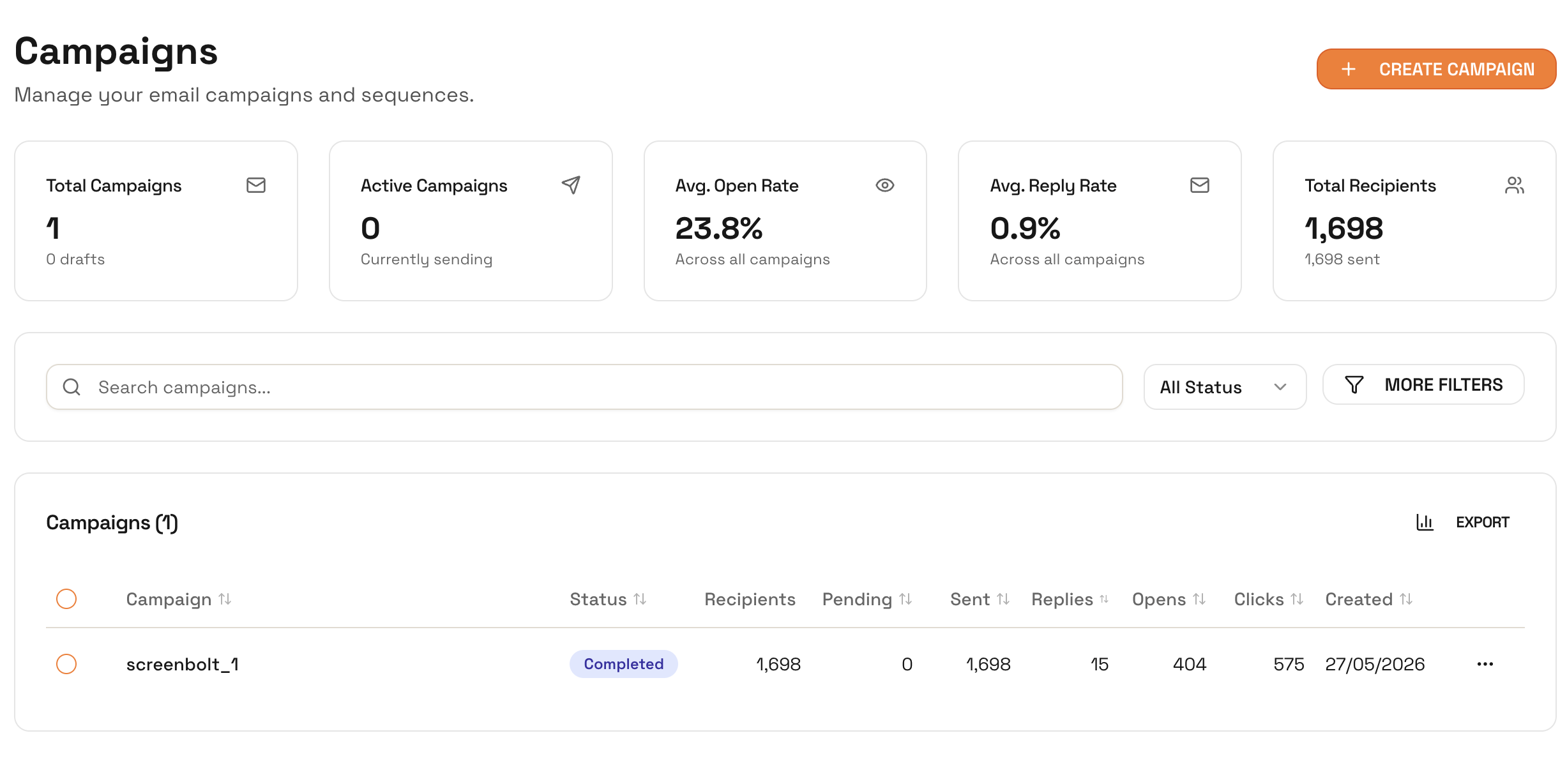
That doesn't mean nothing worked. The first meaningful traction came from a simple mix: inbound from our existing email list, sharing the journey publicly in relevant Reddit communities, and outbound email to relevant site owners through Mailneo. Roughly 3K visitors in a month, and enough of them converted to make $1K+ in a week. It was not a giant launch or a viral moment; it was a signal that the product could turn attention into revenue when the right people saw it.
The bottleneck moved from product to distribution
I don't think people have fully absorbed what AI has done to software. The obvious story is that software now has AI inside it. The bigger story is that AI changed the economics of building it. A solo founder can move like a small team, a small team can move like a funded company, and a funded company can prototype ten ideas before lunch and kill nine by dinner.
That is genuinely amazing. It also means the market is filling up with good-enough products. Not junk, either. Working products with clean landing pages, decent onboarding, generated docs, Stripe checkout, a demo video, sometimes a waitlist that looks a lot like momentum.
The old question was whether you could build the thing. The new question is whether you can make the right people notice it, understand it, trust it, and remember it. Most founders are still playing the old game.
I'm not saying product stopped mattering. Bad products still lose, buggy products still churn, confusing products still fail. But building is no longer the rarest skill in the room. The rare skill is distribution, and I don't mean posting more or doing a launch thread once or buying ads before you understand your customer. I mean the system that turns what you are learning into attention, attention into trust, and trust into demand.
That system compounds in a way features rarely do. A feature can be copied. A landing page can be copied. A pricing page can be copied. A founder's audience, point of view, search footprint, email list, customer language, and relationship history are much harder to copy.
That is the part I underestimated. I thought shipping was the hard part; shipping was the entry fee.
What Screenbolt taught me
The idea was straightforward: make it easier to create clean, useful screen recordings and product videos. Landing pages need demos, support teams need walkthroughs, and founders need proof the thing exists. So we built. We moved quickly, cut scope, and got something real into the world, and that part felt like momentum.
The dangerous thing about product momentum is how well it hides distribution weakness. When you're building there is always a next task. Finish a screen. Push a commit. Fix a bug. Make the empty state less sad.
Distribution doesn't reward you like that at first. You publish something useful and nothing happens. You send thoughtful outreach and most people ignore it. You write a landing page and then realize nobody is landing on it. The market does not care how fast you built; it reacts only when enough of the right people understand that you exist and why you matter.
The first proof didn't come from one channel. It came from pairing audiences we already had with focused outbound. We had an existing email list, so we weren't starting cold, and we shared the journey in subreddits where people already cared about demos and product launches and showing software clearly.
Then we ran outbound to relevant site owners through Mailneo. One campaign sent 1,698 emails and produced 404 opens, 575 clicks, and 15 replies, with a 23.8% average open rate and a 0.9% average reply rate.
None of those numbers are life-changing on their own. Stacked with the existing list and the Reddit attention, they were enough to produce the first $1K+ week and prove distribution wasn't a theory. The lesson underneath the numbers was about targeting rather than volume: the email worked when it went to someone with a relevant site and connected back to a problem they already understood. It was never "please buy my tool." It was closer to "you need a better way to show what your product does, and here is a practical one."
Most founders hide inside product work
I say this carefully because I have done it too. Many of us use product work to avoid the discomfort of distribution.
Adding another feature feels responsible. Writing a sharp opinion in public feels exposed. Improving onboarding feels rational. Emailing potential customers feels like rejection scheduled in advance. Publishing consistently feels like shouting into a room where nobody asked for you.
So we hide inside the product and say: once this feature is done, we'll launch properly. Once onboarding is smoother, we'll do outreach. Once we have three more integrations, people will take us seriously.
Sometimes that's true. Usually it's fear wearing a roadmap costume.
The uncomfortable question is not what else we can build. It's who knows this exists. If the answer is almost nobody, another feature probably will not save you.
The distribution system we're building
I used to think distribution was an event. Build, then launch. Launch, then get users. Users, then growth. That's the clean version people tell after the story already worked.
The real version is messier, and it loops. You build a little, talk about the problem, learn what people misunderstand, rewrite your positioning, publish the lesson, test it on social, turn proven demand into search assets, watch for buying signals, follow up by email, and feed the replies back into the product. That's the distribution system we're running now. Not a hack, not a launch stunt; a repeatable process.
It starts with language, not tools
What are people already saying when they describe the problem? Where do they get stuck? What do they search for when nobody is watching? What do they ask in DMs, support tickets, demos, and sales calls?
For Mailneo, the real language is not "AI-powered email automation platform." It's closer to: how many follow-ups should I send? Why are my outreach emails not getting replies? How do I nurture leads without annoying them? What should a cold email sequence look like for SaaS?
Those aren't keywords. They're customer anxieties, and good distribution starts there.
Repeated questions become content, then search assets
Content is where the learning becomes public. Not content for its own sake, and not "10 tips to grow your SaaS" because a keyword tool suggested it. The best founder content usually starts with a scar: something took longer than expected, something customers kept asking, or something you believed six months ago that now feels naive.
For Mailneo that means writing honestly about email marketing for SaaS, deliverability, segmentation, cold email versus warm email, and lead nurturing. For Screenbolt it means writing about demos, product videos, and why software companies need to show rather than tell.
SEO is easy to disrespect when you're impatient. It feels slow, it feels crowded, and it feels unfair that a giant domain can publish a mediocre post and outrank you. It's still worth doing, because search captures intent at the exact moment someone admits they have a problem. On social you interrupt the feed; on search the user raises their hand. That's where Outrank fits for us, turning proven customer questions into structured search assets.
The important word is proven. I don't want to generate content because a keyword exists. I want to write it after hearing the pain enough times to know it's real.
Social tests the message; LinkedIn reveals intent
For founders, social is less a traffic channel than a language lab. You learn what people react to, what they misunderstand, what they ignore, and what they repeat back to you in their own words. Some posts die because the idea is weak, some because the framing is weak, and some because you haven't earned enough trust yet; telling those apart is most of the skill. A scheduler like Post Bridge makes consistent publishing easier once the message is worth testing. It does not create a point of view.
The step I used to skip entirely was the middle layer between cold lists and warm intros: people showing intent in public before they ever fill out a form. Someone posts that they're struggling with outbound. Someone comments about switching tools. Someone hires for a growth role. Someone asks their network for recommendations. Those are buying signals, and GojiberryAI exists to catch them on LinkedIn rather than blasting a cold list. Don't interrupt everyone; find the people already showing the problem, then start a useful conversation.
Email turns loose attention into a relationship
Not blasting, not guilt-tripping, and not "just bumping this" forever.
Thoughtful outreach matters because the right person will not magically discover you. Follow-ups matter because people are busy rather than uninterested. Nurture sequences matter because the timing is rarely right on the first touch, and most people aren't ready the first time they hear about you. If you want the sequence structure rather than the philosophy, our SaaS email flows lay it out, and the cold outreach swipe file has the openers we adapted for the Screenbolt campaign.
Then the loop closes. The questions people ask should influence onboarding. The objections should influence the pricing page. The repeated pain points should influence features. The best content becomes sales enablement, and the best sales conversations become content. Distribution shouldn't sit downstream from product; it should shape it.
The mistakes we made
I wish I could say we knew all this from the start. We didn't.
We waited too long to talk about the problem. At the time it felt like focus; now I think there's a difference between focus and invisibility. We treated launch like a finish line, when the product going live only means the market can now begin ignoring it. We got bored of our own message far too early, which is a specific founder disease: you hear your positioning every day, and the market has barely heard it once.
And we confused tools with channels. A scheduling platform is not a social strategy. An SEO content platform is not a point of view. An outreach platform is not trust. Tools help you operate a strategy; they don't replace it.
The order matters too, and that's the part I keep coming back to. Start with email before you understand the market language and you just automate confusion. Start with SEO before you know which questions actually hurt and you produce content that looks useful but never touches buying intent. Start with social before you have a point of view and you become one more founder posting vague updates. Start with LinkedIn intent before you know what signal matters and you'll mistake activity for opportunity.
Customer conversations create language. Language creates content. Content creates search and social assets. Search and social reveal intent. Intent makes outreach relevant. Outreach creates replies. Replies improve the product and the next round of content.
That's why I don't want to talk about tools as a bundle. Bundles feel like shortcuts, and distribution is not a shortcut; it's a sequence of small connected behaviors repeated long enough that the market starts to remember you.
The hard truth
If you're building software right now, your product is probably not your biggest problem. Attention is. Trust is. Positioning is. Follow-up is. The ability to explain why your thing matters is.
That doesn't mean stop building. It means stop hiding inside building. The AI era rewards builders and will punish invisible ones, and the founders who win won't just ship more; they'll distribute better, make their learning visible, and build systems that keep working after the launch post disappears.
Here's the line I keep coming back to.
A product no one sees is not a business. It is a private achievement.
That one hurts because it's true. I have had private achievements. They feel meaningful to the builder, and they do not pay salaries, create momentum, or help a single customer who never finds them. Which is why distribution deserves founder-level attention rather than "we'll post when we have time" attention.
We built the product in 30 days. Getting customers is taking ten times longer. That might be the most useful lesson so far, and we're documenting the rest of it publicly as it happens.
Explore: Email Marketing Strategy
Related Articles
Email Marketing for SaaS: The Complete Playbook
Email marketing for SaaS is lifecycle-driven and product-triggered; every send is tied to where a user sits in the activation, adoption, or renewal arc. Done right, it moves trial-to-paid conversion by double digits and cuts churn before CS ever needs to get involved.
The Future of AI in Email Marketing
AI email marketing trends in 2026 point toward predictive personalization, generative content at scale, and multimodal campaigns. Here's what's already shipping, what's hype, and what operators should actually prepare for over the next two to three years.
Cold email vs warm email: when to use each
Cold email vs warm email comes down to consent and context. Cold email targets strangers for B2B outreach (response rates of 1-5%); warm email nurtures opted-in subscribers (open rates of 20-40%). Each has different legal rules, different metrics, and different tools.
Lead Nurturing Email Examples: 9 Sequences to Steal
Lead nurturing emails move a prospect from early interest to sales readiness with useful, timed messages. The strongest sequences teach, qualify, and reduce risk before asking for a call. This guide gives nine practical examples, copy angles, timing rules, and measurement notes.
Ready to supercharge your email marketing?
Start sending smarter emails with AI-powered campaigns. No credit card required.
Get Started Free