Master B2B Appointment Setting: Playbook for Qualified Meetings
B2B appointment setting works when it operates as a revenue system, not calendar admin. This playbook covers ICP targeting, multi-channel outreach, qualification, measurement, and automation so teams can turn the right accounts into qualified conversations.
 Sohail Hussain17 min read
Only 21% of B2B marketers prioritize appointment setting even though 90% say it drives results, according to an industry guide summarized in this ROI discussion. That gap says a lot. While many organizations know meetings matter, many still treat appointment setting like calendar admin or a junior cold-calling task.
That approach breaks fast in modern outbound. Buyers research on their own, compare vendors before replying, and ignore generic outreach across email, phone, and LinkedIn. Good B2B appointment setting isn't about squeezing more calls into the day. It's about building a repeatable system that turns the right accounts into qualified conversations.
For SaaS teams, that means finding accounts with real timing and stack fit. For e-commerce brands, it means targeting operators with a revenue problem you can tie to margin, retention, or lifecycle growth. For agencies, it means filtering out tire-kickers before they ever hit a strategy call.
Why B2B Appointment Setting Is a Revenue Engine
B2B appointment setting became a formalized sales function as companies moved away from loose outbound prospecting and toward structured qualification and meeting coordination, as outlined in this strategic guide to appointment setting. That's the right way to think about it today. It isn't a side task. It's the front end of pipeline creation.
Teams that run it well don't measure effort by how many emails went out. They measure whether the system consistently identifies target accounts, qualifies interest, books meetings for closers, and tracks conversion through the funnel. If that sounds closer to revenue operations than admin support, it should.
From admin task to pipeline function
The strongest appointment-setting motions have four operating parts:
- Target selection: Pick accounts that match your ICP instead of blasting a broad list.
- Contact strategy: Reach buyers through a sequence, not a one-off message.
- Qualification: Check for fit, timing, and next-step potential before handing off.
- Performance tracking: Monitor connection rate, qualification rate, show rate, and what happens after the meeting.
That last part is more significant than many acknowledge. A calendar full of weak meetings creates fake confidence. A lighter calendar with stronger fit gives account executives something they can close.
Practical rule: If your setters can't explain which meetings become real opportunities, they're booking activity, not pipeline.
For leaders, this changes staffing and management. You don't hire appointment setters to "get more at-bats." You hire them to create qualified conversations with enough context that the closing team can move quickly. If you want to pressure-test economics, a sales ROI calculator helps frame the discussion around downstream value instead of raw output.
Why the buyer journey changed the job
Modern buyers don't wait for a rep to educate them. By the time they engage, they often already know the category, shortlist, and likely objections. That means B2B appointment setting now sits at the point where timing, relevance, and qualification all meet.
For SaaS, this usually means your rep needs to know more than title and company size. They should know what system the account already uses, what change might trigger interest, and whether the contact can pull in the rest of the buying group.
For e-commerce and agency sales, the same principle applies. The first meeting has to feel earned. If your outreach reads like mass prospecting, buyers assume the meeting will be generic too.
Appointment setting works when the prospect feels the meeting solves a real business question, not when they feel they've been processed into a calendar slot.
Building Your Target List with an ICP
Most appointment-setting problems are targeting problems wearing a messaging costume. Teams blame reply rates, scripts, or channel mix when the underlying issue is simpler. They built a list of people who were never likely to care.
Recent neutral research summarized in this overview of appointment setting notes that buyers now complete a large share of their decision process before talking to sales, which raises the bar for ICP targeting and buying-signal research. If buyers are self-educating, your job is to catch fit plus timing, not just fit alone.
Start with commercial fit, not broad market fit
A useful ICP is specific enough to exclude most of the market. It should answer five practical questions:
| ICP layer | What to define | What reps should look for |
|---|---|---|
| Firmographic | Industry, company size, geography | Does this business look like customers you already serve well? |
| Role fit | Titles, seniority, functional ownership | Who feels the problem and who signs off? |
| Operating model | Tech stack, sales model, growth stage | Does your offer fit how they actually run the business? |
| Pain trigger | Known bottlenecks, workflow gaps, cost pressure | What business issue creates urgency for a meeting? |
| Buying context | Hiring, funding, launches, leadership shifts | Why now, not later? |
An ICP that says "mid-market companies" isn't useful. An ICP that says "Shopify Plus brands with an in-house lifecycle team, selling repeat-purchase products, where retention is flattening" is useful because it changes the message, the proof points, and the meeting agenda.
A segmented list is easier to personalize and easier to automate cleanly. That's why list-building should behave more like a campaign architecture problem than a contact scraping exercise. If your team needs a practical framework, this guide to email list segmentation is worth reviewing before you build the first sequence.
Use-case examples for SaaS, e-commerce, and agencies
Here's how that looks in practice.
SaaS
A SaaS company selling workflow or analytics software shouldn't target every company in its category. It should target accounts with visible process complexity, tool sprawl, or a known competitor in place. Good list criteria might include product-led firms hiring RevOps, support teams rolling out new systems, or engineering-heavy companies where integrations matter.
What usually fails is generic "save time" messaging to a broad software list. What works is showing that you understand the operational environment the prospect already lives in.
E-commerce
E-commerce brands should resist broad DTC targeting. The better path is to define around catalog complexity, repeat purchase behavior, fulfillment model, and lifecycle maturity. A retailer with a simple one-time purchase model has different economics from a brand that depends on repeat orders and segmented retention flows.
That changes who should receive outreach too. Sometimes it's the CRM lead. Sometimes it's the head of growth. Sometimes the founder still owns the problem.
Agencies
Agencies need an especially tight ICP because low-fit meetings eat strategy time fast. Good indicators include new funding, a team that recently hired a marketing lead, a site relaunch, or signs of channel expansion. Bad indicators are broad "needs marketing help" assumptions.
The best agency lists don't ask, "Who might buy services?" They ask, "Who has a live commercial reason to change vendors or add support?"
Turn the ICP into a working list
Once the ICP is clear, build the list from systems your team can verify, not guess from. In practice, that usually means:
- CRM history: Pull common traits from won accounts and stalled accounts.
- LinkedIn Sales Navigator: Filter by title, headcount, geography, and growth clues.
- Company websites and directories: Confirm positioning, product lines, and market focus.
- Team research notes: Add reasons for outreach, not just contact records.
Then rank accounts. Tier 1 gets manual research and stronger personalization. Tier 2 gets templated messaging with custom inserts. Tier 3 stays out of the sequence until you have a better reason to contact them.
That discipline is what keeps B2B appointment setting efficient. A smaller, sharper list almost always beats a broader one with weak intent signals.
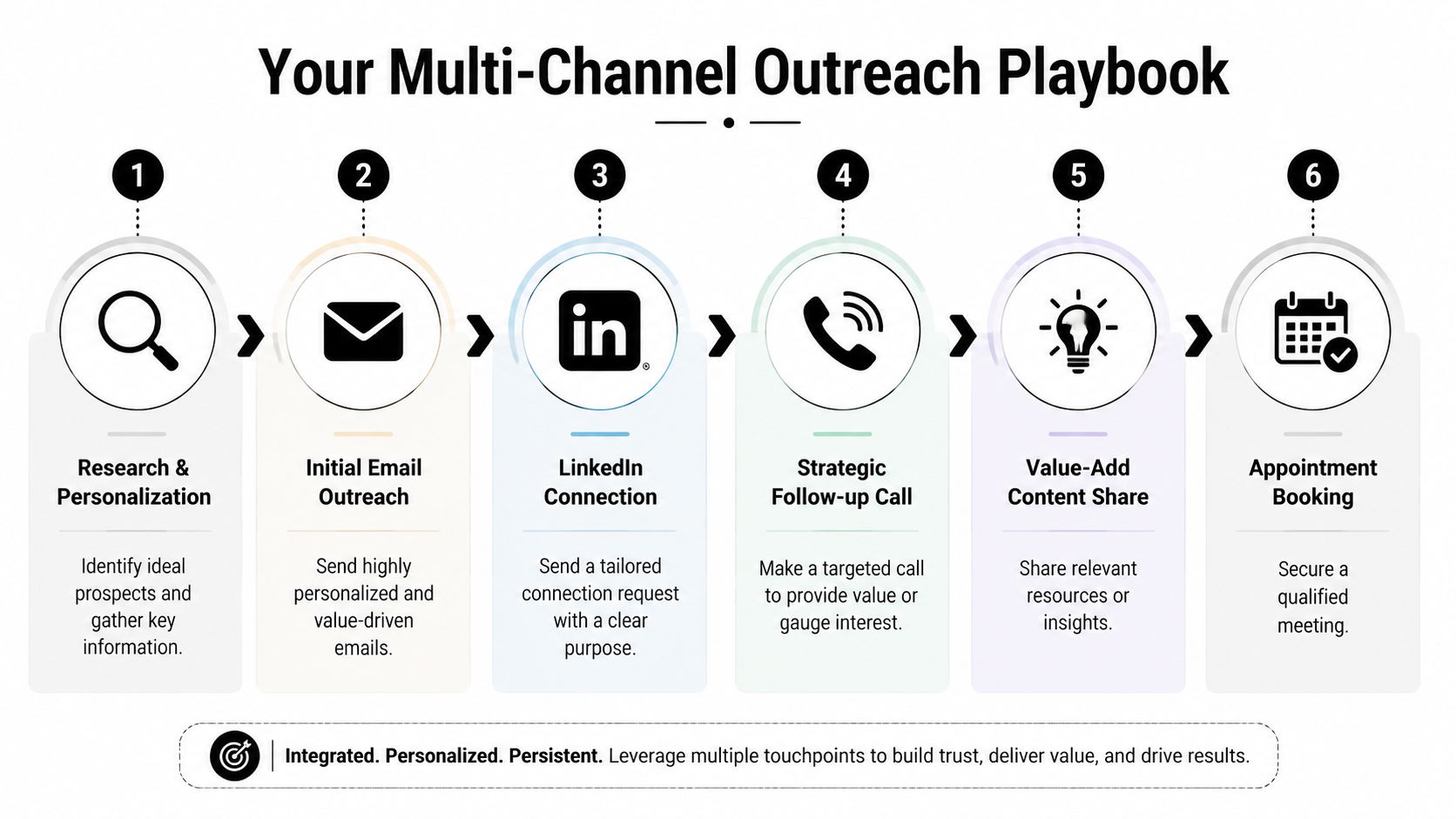
Your Multi-Channel Outreach Playbook
Single-channel outreach leaves too much to chance. Buyers ignore email, miss calls, and skim LinkedIn at odd hours. A proper appointment-setting motion uses all three together, with each touch supporting the others.
Expert guidance summarized in this B2B appointment setting guide notes that booking a meeting often takes 8 to 12 touches and that appointment conversion benchmarks are commonly in the 2% to 5% range across many industries. That should reset expectations. One email and one voicemail isn't persistence. It's barely an attempt.
What a working sequence looks like
I like a 12-touch sequence across 21 days because it creates enough repetition to be noticed without turning into spam. The exact day spacing can change by market, but the structure should look something like this:
- Day 1 email with a sharp reason for reaching out.
- Day 3 LinkedIn view or connect request tied to the same pain point.
- Day 4 call to test reach and surface interest.
- Day 6 follow-up email with a different angle or use case.
- Day 8 LinkedIn message after connection.
- Day 10 call with a tighter opener.
- Day 12 email sharing a relevant observation.
- Day 14 voicemail or call attempt if the contact is reachable by phone.
- Day 16 email that lowers friction and asks for a short fit check.
- Day 18 LinkedIn nudge with one-line context.
- Day 20 call to close the loop.
- Day 21 breakup email that leaves the door open.
Use a swipe library, but don't let it turn your team into template robots. Good reps start with proven structure and then customize the first reason-to-care. A curated set of cold outreach examples can speed up that process.
Channel guidance that actually works
Each channel should do a different job.
- Email carries the main message. Keep it short, relevant, and easy to reply to.
- Phone tests seriousness. It also uncovers gatekeeping, role mismatch, and timing faster than inbox waiting.
- LinkedIn builds familiarity. It works best as reinforcement, not as your only engine.
- SMS can help in some workflows after contact is established, but it shouldn't be your opening move unless the market clearly accepts it.
A practical workflow described in this appointment-setting process guide recommends building ICP lists, using multi-channel outreach that can include phone, email, LinkedIn, and SMS, qualifying with a framework such as BANT, then locking the meeting with invites and reminders.
Good multi-channel outreach doesn't repeat the same pitch in three places. It advances the same conversation from three angles.
Templates you can adapt fast
Email opener
Subject lines don't need to be clever. Relevance wins.
Hi [First Name],
Noticed [specific trigger or operating context]. Reaching out because teams in [industry/use case] often hit [specific problem] when that happens.
Worth a quick conversation to see whether this is on your radar?
Why it works: it starts from the prospect's world, not your product.
LinkedIn connection request
Hi [First Name], saw your work around [team, channel, initiative]. Reaching out because we help teams dealing with [specific issue]. Thought it made sense to connect.
Why it works: it doesn't cram a pitch into the request.
Call opening
Hi [First Name], this is [Rep] calling because I sent a note about [problem]. I don't know if the timing is right, but I wanted to ask one quick question before I let you go.
Why it works: it sounds human, lowers pressure, and earns the next sentence.
The biggest mistake in B2B appointment setting is forcing every contact into the same sequence. Enterprise SaaS buyers may need more account research and slower follow-up. E-commerce operators often respond better to direct problem framing. Agency prospects usually require proof of fit quickly because they get pitched constantly.
Qualifying Prospects Without Wasting Time
A weak appointment-setting team celebrates booked meetings. A strong one protects the calendar.
That difference matters because speed and quality are linked. HubSpot's 2024 sales benchmark data, cited in this appointment-setting services analysis, found that the odds of qualifying a lead fall sharply after the first five minutes. The same source also notes that independent guides report show rates are often only in the 50% to 65% range without strong confirmation workflows. If your team waits too long to qualify, or treats booking as the finish line, the funnel leaks twice.
Qualify early and lightly
Qualification doesn't need to sound like an interrogation. In fact, if it does, you'll kill momentum. The job is to establish whether the meeting deserves seller time and whether the buyer has a real reason to continue.
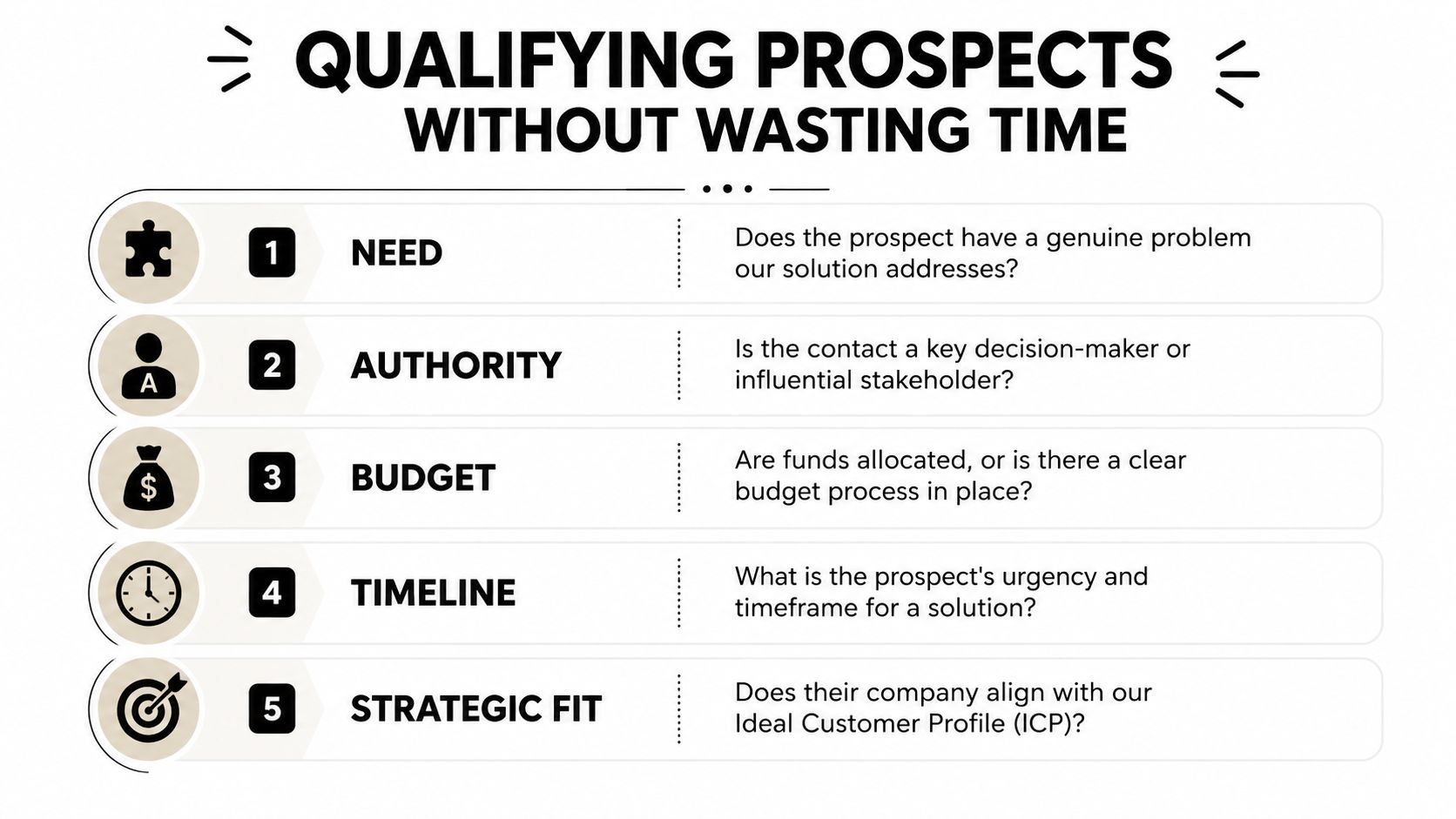
A lightweight BANT-style check still works well in first conversations:
- Need: Is there a defined business issue?
- Authority: Is this person involved in the buying process?
- Budget: Is there a realistic path to spending?
- Timeline: Is this active, emerging, or hypothetical?
- Strategic fit: Does the account belong in your ICP?
Here's a useful training asset on the topic:
How to lock in the meeting
Once the prospect is qualified enough for a next step, the booking process needs structure. At this stage, too many teams get sloppy. They hear mild interest, send a vague calendar link, and hope for the best.
A better workflow looks like this:
- Confirm the reason for the meeting: Restate the business issue in one sentence.
- Set the right attendee mix: Ask whether anyone else should join.
- Send the invite immediately: Include date, time, agenda, and expected outcome.
- Add reminder touches: Use email and, where appropriate, SMS reminders.
- Reduce uncertainty: Tell the prospect exactly what the first meeting will and won't cover.
If you're tightening attendance, these outreach strategies for fewer no-shows are a practical reference because they focus on confirmation habits, reminder timing, and clarity.
A booked meeting is still fragile until the buyer accepts the invite, understands the agenda, and knows why showing up is worth their time.
Questions that filter without killing momentum
You don't need to ask, "Do you have budget, authority, need, and timeline?" You need natural prompts that reveal the same information.
Try questions like these:
- For need: "What's pushing this onto your radar right now?"
- For authority: "Who else usually weighs in when this kind of decision comes up?"
- For budget path: "How do you normally evaluate and fund something like this?"
- For timeline: "Is this a current initiative or something you're scoping for later?"
- For fit: "What have you tried so far?"
If the prospect can't describe a problem, doesn't know who else is involved, and offers no timing signal, don't force the meeting. Put them back into nurture or a lighter-touch sequence. B2B appointment setting gets expensive when setters hand over curiosity dressed up as pipeline.
How to Measure Appointment Setting Success
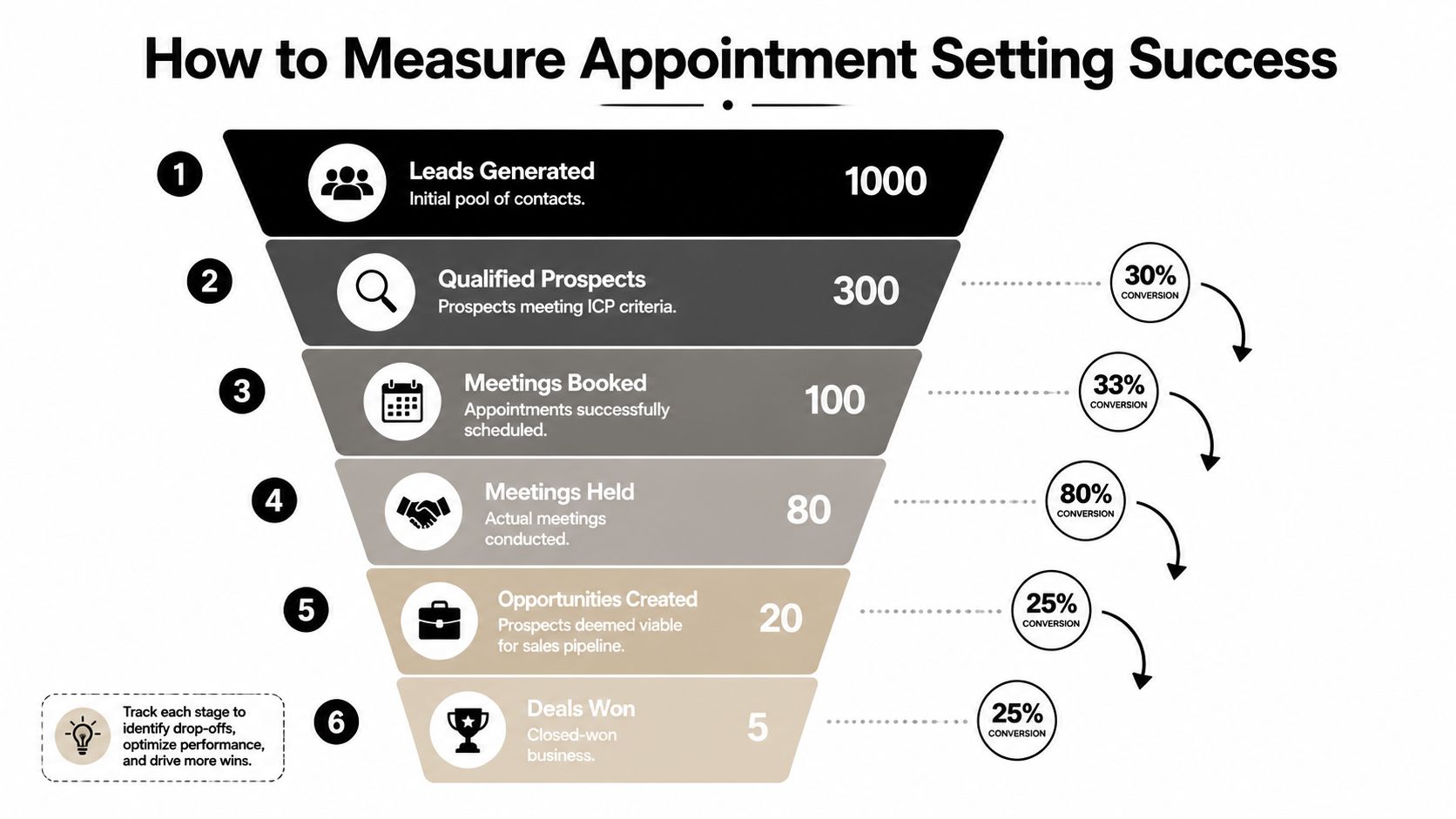
Fewer than all booked meetings happen, and fewer than all attended meetings turn into pipeline. That is why meetings booked is a volume metric, not a performance metric.
Measure appointment setting the same way you would measure any revenue motion. Track what gets scheduled, what gets attended, what gets accepted by sales, and what turns into real opportunities. If one stage breaks, the fix is usually different by channel. Low reply rates often trace back to email targeting and copy. Low connection rates usually point to list quality, mobile coverage, or poor call blocks. Strong booking volume with weak opportunity creation often comes from soft qualification or a sloppy handoff.
The metrics that show where the funnel is leaking
Track the funnel in layers.
| Metric | What it tells you | If it's weak, check this first |
|---|---|---|
| Connection rate | Whether reps are reaching real people | Data quality, calling windows, role selection |
| Positive reply rate | Whether the message earns interest | Offer clarity, relevance, segmentation |
| Qualification rate | Whether conversations are with the right people | ICP quality, list filters, rep discovery skill |
| Set-to-show rate | Whether booked meetings actually happen | Confirmation process, agenda quality, timing |
| Opportunity conversion | Whether meetings become pipeline | Qualification rigor, handoff quality, meeting fit |
| Appointment-to-sale conversion | Whether the motion creates revenue | Targeting, sales execution, account quality |
This scorecard makes diagnosis harder to fake. A rep does not fix a weak positive reply rate with more activity if the sequence misses the buyer's problem. A manager does not fix weak opportunity conversion by asking for more meetings if SDRs are booking outside the ICP.
Channel context matters here.
For SaaS teams, I watch conversion by persona, trigger, and demo type. A meeting with a VP of Operations after a funding event may convert very differently from a meeting with an individual contributor who downloaded a guide. For e-commerce, source matters more than teams expect. Founder-led brands, retention managers, and heads of growth often respond to different offers and move at different speeds. For agencies, vertical and deal size usually decide whether discovery turns into a real pipeline asset or a time sink.
A simple scorecard for weekly review
Use a weekly review that forces decisions, not reporting.
- Which segments are producing qualified meetings?
- Which messages are creating positive replies?
- Where are no-shows happening most often?
- Which reps are setting meetings that convert to opportunities?
- Are AEs accepting the quality of meetings being handed over?
- What changed in the last sequence iteration?
I also separate channel performance instead of blending everything into one dashboard. Email may drive replies. Phone may drive contact and recovery on stalled accounts. LinkedIn may improve familiarity before a call lands. If you lump those together, you miss where the actual lift came from and where automation is helping versus creating noise.
Operator's view: The best appointment-setting dashboards show where to intervene this week, by segment, message, rep, and channel.
Review bookings alone and problems stay hidden until late in the quarter. Review set rate, show rate, qualification, opportunity creation, and closed revenue together, and you can see whether your SaaS, e-commerce, or agency motion is producing meetings that sales would want again.
Tools and Automation for Smarter Outreach
Smart automation helps B2B appointment setting scale without turning it into robotic spam. The key is to automate sequence mechanics and data hygiene while keeping research, judgment, and qualification human.
What to automate and what to keep human
Automation is useful when the task is repetitive, rules-based, and easy to audit.
Automate things like:
- Sequence execution: Scheduled follow-ups across email and task queues.
- List enrichment: Pulling in role, company, and contact details.
- Reminder workflows: Calendar confirmations and attendance nudges.
- Message testing: Running controlled variations on subject lines and copy blocks.
- CRM logging: Keeping activity and disposition updates consistent.
Keep these human:
- Account research: Understanding why this company should care now.
- Personalization logic: Choosing the right angle, not just inserting a variable.
- Call handling: Objection management, qualification, and tone.
- Handoff notes: Giving the closer context that improves the first meeting.
A practical stack by team type
Different teams need different levels of tooling.
- SaaS teams: Usually need a CRM, a sales engagement tool, LinkedIn workflow support, and a clean process for routing qualified meetings to account executives.
- E-commerce brands: Often benefit from lightweight outreach systems tied to segmentation, retention pain points, and faster founder or operator follow-up.
- Agencies: Need strong list management, reusable messaging frameworks, and automation that supports multiple client audiences without mixing them up.
The key isn't more automation. It's better allocation. Software should handle the repetitive work so reps can spend their time on account selection, sharp messaging, and live conversations that move deals forward.
Mailneo helps teams run that kind of outreach with less manual work. If you want a simpler way to manage email sequences, personalize campaigns, and support smarter appointment-setting workflows, take a look at Mailneo.
Explore: Email Marketing Strategy
Related Articles
Business to Business Mailing Lists: A 2026 Guide
Business to business mailing lists are revenue datasets, not static rosters. This guide explains when to build, buy, or enrich B2B lists, how to vet vendors, and how to keep data clean, compliant, and useful for campaigns.
Outbound & Inbound Marketing: A Unified Email Strategy
Inbound and outbound email should work as one pipeline system. This guide explains how inbound signals can trigger better outbound follow-up, how to choose the right motion, and how to measure the handoff from interest to conversation.
Pay Per Lead Marketing: A Complete Guide for 2026
Pay per lead marketing can work when the billable event, validation rules, handoff process, rejection terms, and unit economics are clearly defined. This guide explains how to manage PPL programs without paying for low-quality demand.
Newsletter growth: how to get your first 1,000 subscribers
Growing an email list to 1,000 subscribers takes a small set of on-site forms that convert, two or three off-site channels you actually enjoy posting to, and an onboarding sequence that keeps new readers around. This guide covers the realistic timelines, the channel mix that works, the tactics that waste your time, and what to avoid.
Ready to supercharge your email marketing?
Start sending smarter emails with AI-powered campaigns. No credit card required.
Get Started Free