Outbound & Inbound Marketing: A Unified Email Strategy
Inbound and outbound email should work as one pipeline system. This guide explains how inbound signals can trigger better outbound follow-up, how to choose the right motion, and how to measure the handoff from interest to conversation.
 Sohail Hussain18 min read
Most advice about outbound and inbound email is still stuck in a false choice. Build content or do cold outreach. Wait for demand or create it. Nurture or prospect.
That framing hurts small and midsize teams because real pipelines don't behave that neatly. A buyer reads a guide, ignores your newsletter, checks your pricing page, gets busy, then finally replies when a sales rep sends a short email that reflects what they already looked at. Was that inbound or outbound? Operationally, it was both.
The better model is simple. Inbound captures interest. Outbound converts momentum into conversation. If you split them into separate worlds, your email program gets slower, noisier, and harder to measure. If you combine them, you get timing, context, and a cleaner path from first touch to booked meeting or purchase.
For SMBs, this matters even more. You usually don't have the budget for a content engine that waits months to mature, and you also can't afford blind outreach to cold lists with weak targeting. The practical answer is a unified system where inbound signals tell you who deserves outbound attention, and outbound follow-up gives your inbound leads a faster path to action.
The End of Inbound Versus Outbound
The old debate assumes each motion wins under its own rules. That's no longer how effective email programs run.
In B2B operations, outbound is seller-initiated and inbound is buyer-initiated, but the practical question isn't which camp you're in. It's how well you connect buyer intent to the next appropriate action. When a prospect raises a hand through content, a demo request, a webinar registration, or product activity, that inbound behavior becomes context. Outbound can then use that context to send a better email, to the right person, at the right time.
The strongest programs treat both motions as parts of the same system. Inbound creates permission and relevance. Outbound adds speed and control. Used alone, each has a weakness. Inbound can produce passive lead queues that sit too long. Outbound can create volume without enough context to feel timely.
Practical rule: Stop asking which channel is better. Ask which buyer signals should trigger human outreach, and what that outreach should reference.
That shift changes everything. It changes who marketing sends to sales. It changes how reps write follow-ups. It changes which metrics matter. Most of all, it transforms outbound & inbound from a philosophical argument into an operating model.
Two Philosophies: The Magnet and The Megaphone
The simplest way to understand outbound & inbound email is to stop thinking in platform terms and start thinking in communication terms. Inbound is a magnet. It attracts people who already have some level of interest. Outbound is a megaphone. It pushes a message outward to people you want to reach before they've raised a hand.
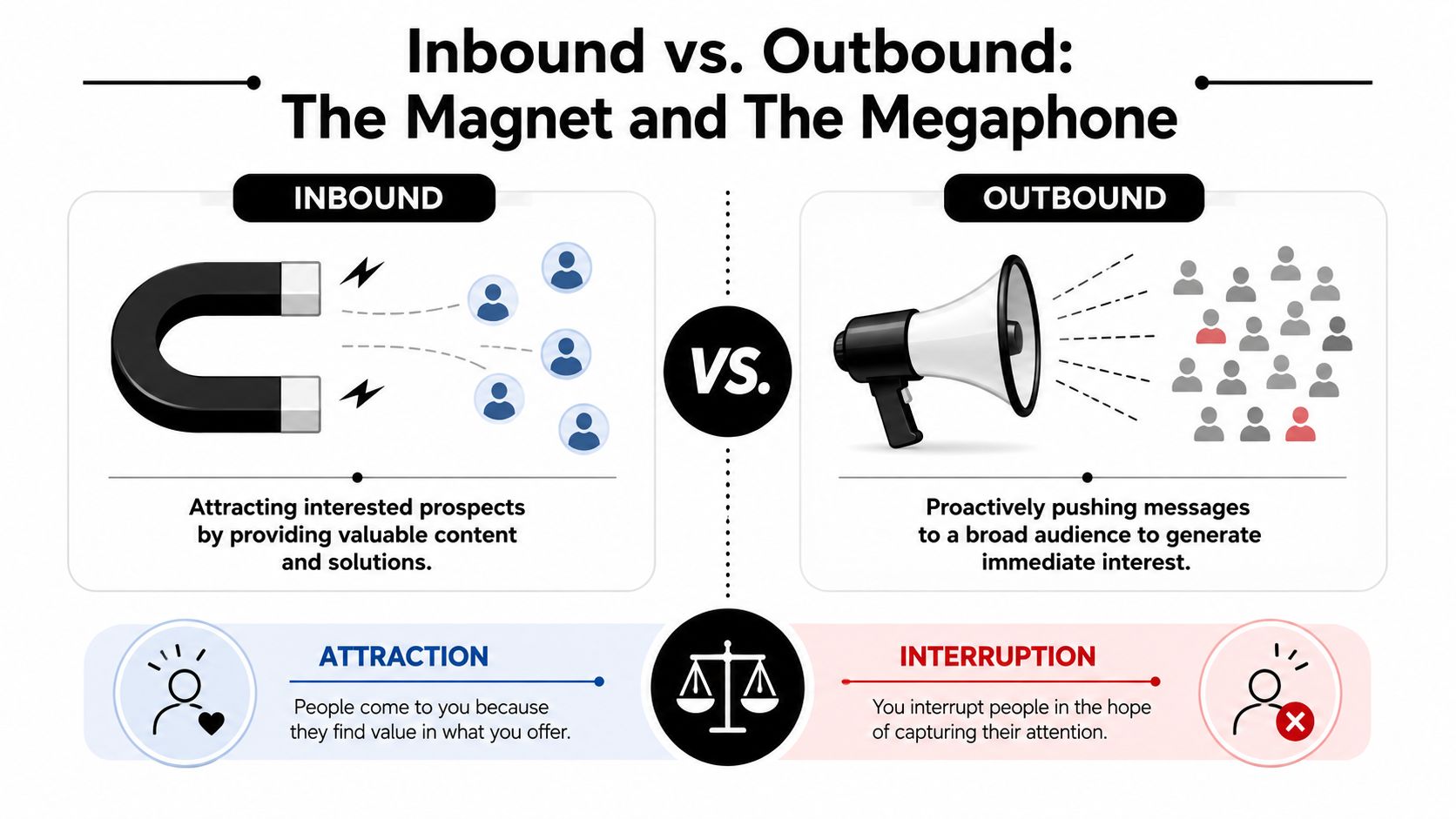
Inbound as the magnet
Inbound email starts after the prospect does something first. They subscribe, request a guide, join a waitlist, start a trial, or fill out a contact form. The relationship begins with expressed interest.
That changes the tone of the email. You're not introducing yourself out of nowhere. You're continuing a conversation the buyer already started.
In B2B, that buyer-initiated motion means the audience is already self-selected. The operating job becomes conversion-path optimization. You focus on landing pages, forms, welcome sequences, lead scoring, and nurturing logic. The question isn't "How do we get anyone to reply?" It's "How do we move an interested person to the next step without losing momentum?" This framing aligns with Apollo's explanation of the difference between buyer-initiated and seller-initiated motions in their breakdown of inbound and outbound sales.
Common inbound emails include:
- Welcome emails: Confirm subscription and set expectations.
- Lead nurture emails: Deepen problem awareness or show use cases.
- Trial onboarding emails: Push the user toward activation.
- Cart recovery or browse follow-up emails: Tie follow-up to known behavior.
Outbound as the megaphone
Outbound email begins when your team chooses the target and sends the first message. The prospect hasn't asked to hear from you. That's why targeting quality matters so much more.
Seller-initiated outreach depends on strong account selection and contact quality. If your ICP is fuzzy, your message will feel random. If your data is weak, even a good offer lands in the wrong inbox.
The best outbound emails don't sound like broadcasts, even though the motion is proactive. They sound narrow. Relevant. Timed to a business problem or an observable trigger.
Outbound works when the sender has earned relevance before they've earned attention.
Typical outbound use cases include:
- Cold prospecting into target accounts.
- Account-based outreach to specific stakeholders.
- Reactivation emails to stalled opportunities or old leads.
- Signal-based outreach after someone from the account visits high-intent pages.
The real difference is consent, context, and intent
The magnet and megaphone analogy matters because it keeps teams from mixing up tactics.
| Dimension | Inbound email | Outbound email |
|---|---|---|
| Starting point | Prospect shows interest first | Seller starts the interaction |
| Primary tone | Helpful, guiding, permission-based | Direct, hypothesis-driven prospecting |
| Main operational lever | Better conversion paths | Better targeting and personalization |
| Common failure | Weak follow-up after initial interest | Generic messaging to poor-fit lists |
If you remember one distinction, use this one. Inbound responds to existing intent. Outbound tries to create a conversation before intent is explicit.
A Head-to-Head Comparison of Inbound and Outbound
The easiest way to compare outbound & inbound email is to look at how each behaves under everyday operating pressure. Not in theory. In a real team with limited time, a finite budget, and quarterly targets.
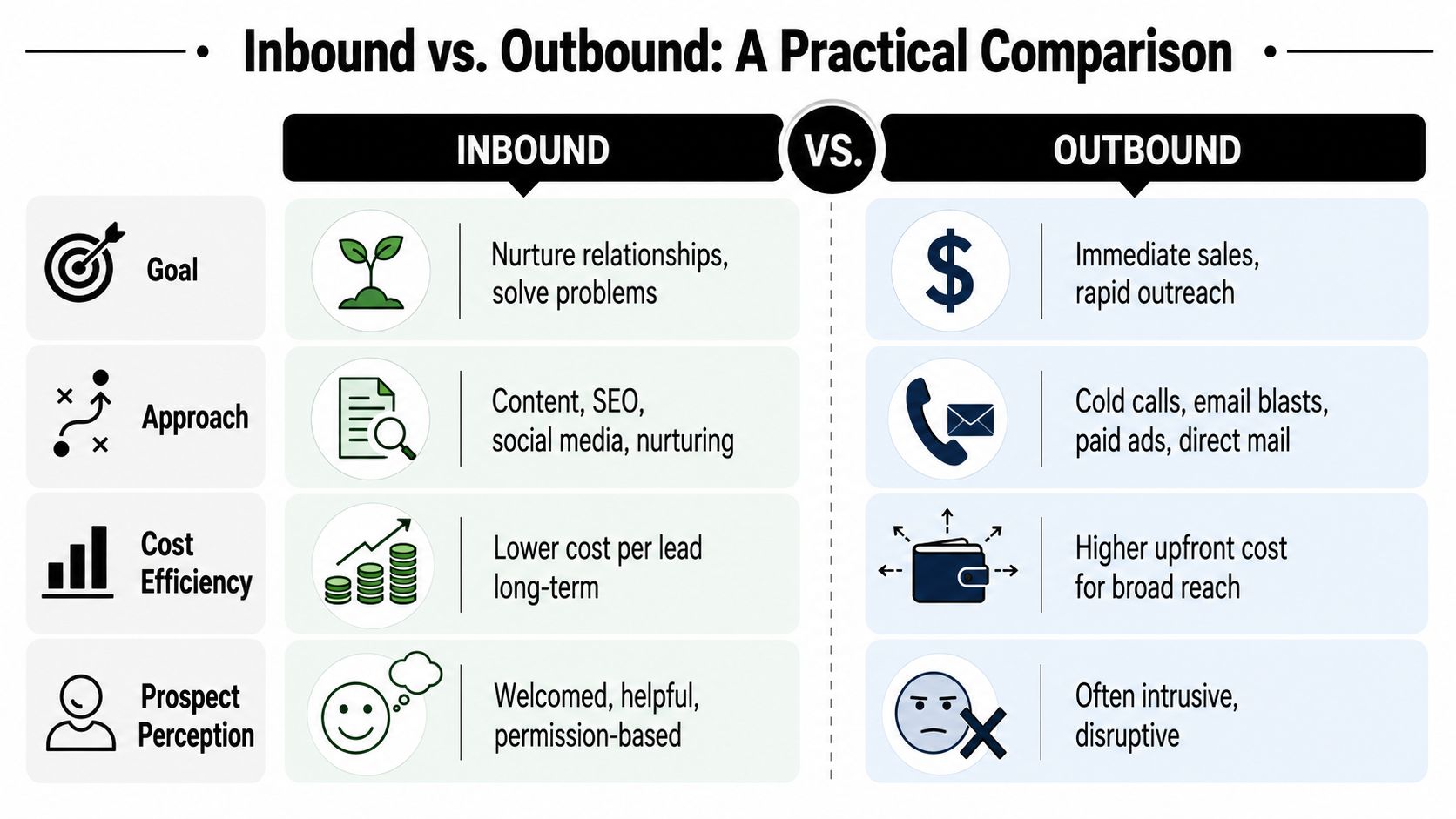
Where each motion starts
Inbound starts with known interest. Someone visits, subscribes, downloads, signs up, or requests something. Your email system responds to that action.
Outbound starts with a target list. Your team identifies accounts, selects contacts, writes messaging, and initiates the sequence. That makes outbound more controllable, but also more exposed to bad data and weak segmentation.
For teams that also manage phone outreach, the same logic shows up there too. This inbound versus outbound calling guide is useful because it shows how initiation changes tone, expectations, and workflow across channels, not just email.
Cost structure and scaling behavior
Inbound usually asks for more upfront asset creation. You need landing pages, lead magnets, signup forms, automations, templates, and often content that keeps earning attention over time.
Outbound shifts the burden toward list building, research, copywriting, deliverability discipline, and rep time. It can launch faster, but it doesn't compound the same way unless you keep feeding it better data and tighter messaging.
A simple side-by-side view helps:
| Criteria | Inbound | Outbound |
|---|---|---|
| Audience source | Permission-based subscribers and hand-raisers | Prospect lists and named accounts |
| Primary goal | Nurture and convert existing interest | Initiate conversations and create pipeline |
| Main investment | Content, automation, conversion flow | Data quality, personalization, rep execution |
| Scaling pattern | Compounds as assets keep working | More linear because activity must continue |
| Typical tools | CRM, forms, email automation, analytics | CRM, sales engagement, enrichment, sequencing |
Later in the stack, many teams also need to distinguish between cold and warm email treatment. This short guide on cold email vs warm email helps clarify when a contact should stay in an outbound sequence and when they should move into a warmer nurture track.
What works and what breaks
Inbound works well when your offer matches active demand and your conversion path is clean. It breaks when leads come in and no one follows up with urgency or context.
Outbound works well when you know exactly who you want to reach and why they should care now. It breaks when teams confuse volume with relevance.
“A lot of teams don't have an inbound problem or an outbound problem. They have a timing problem. They contact the right people too late, or the wrong people too early.”
That's why head-to-head comparisons are useful only up to a point. They show the trade-offs, but they don't tell you how to combine both motions. That's where strategy starts.
How to Choose Your Email Strategy
You shouldn't choose one permanent model. You should choose a primary motion for the situation you're in.
A bootstrapped SaaS company with a small brand and a useful niche product often benefits from inbound foundations first. A good lead magnet, a clean trial sequence, and a few high-intent nurture tracks can create steady demand without requiring a full outbound team on day one.
An agency selling to a narrow set of ideal clients usually has the opposite reality. There may not be enough search demand for content alone to carry the pipeline. In that case, outbound becomes the practical lead motion because the team can identify exactly which companies fit, which stakeholders matter, and what business problem to open with.
Match the motion to the buying environment
Use these decision rules:
- Choose inbound-first when buyers already search for your category and you're able to turn visits into signups, demos, or purchases through strong forms and automated follow-up.
- Choose outbound-first when your market is narrow, your average customer value supports manual outreach, or you need to reach specific accounts that won't discover you on their own.
- Choose hybrid early when your inbound program generates useful behavioral signals but not enough direct conversions.
That last category is where most SMBs should pay attention. The strategic question isn't
"Inbound or outbound?" is the wrong question. Ask which inbound signals are strong enough to justify outbound follow-up, and how quickly AI-assisted workflows should act on them.
That framing reflects the hybrid operating model described in this analysis of inbound vs. outbound marketing in the first-party-data era.
A practical way to think about it
Treat inbound as your listening system. Treat outbound as your response system.
If someone downloads a basic educational resource, keep them in nurture. If they visit the pricing page twice, start a trial, or engage with decision-stage content, outbound can step in with a relevant email from a real person. That follow-up shouldn't feel like a cold interruption. It should feel like competent timing.
Decision filter: Outbound should earn the right to act on inbound behavior, not ignore it.
If you're building this from scratch, a focused resource like this high-ROI email strategy for startups is helpful because it forces you to prioritize email motions that match your actual stage, instead of copying enterprise playbooks you can't support yet.
What not to do
Three mistakes show up repeatedly:
- Running pure inbound with slow follow-up. You collect interest and then waste it.
- Running pure outbound without signal context. You create noise and lower reply quality.
- Using the same messaging logic for both. A subscriber and a cold prospect shouldn't get written to the same way.
The right strategy is less about channel loyalty and more about sequencing. Who showed intent? How strong was it? What should happen next?
Building Your Integrated Email Workflow
A unified email system doesn't need an enterprise budget. It needs clean triggers, clear ownership, and a CRM that doesn't turn behavioral data into a dead archive.
The operating model is straightforward. Inbound behavior creates context. Outbound acts on context when the signal is strong enough.
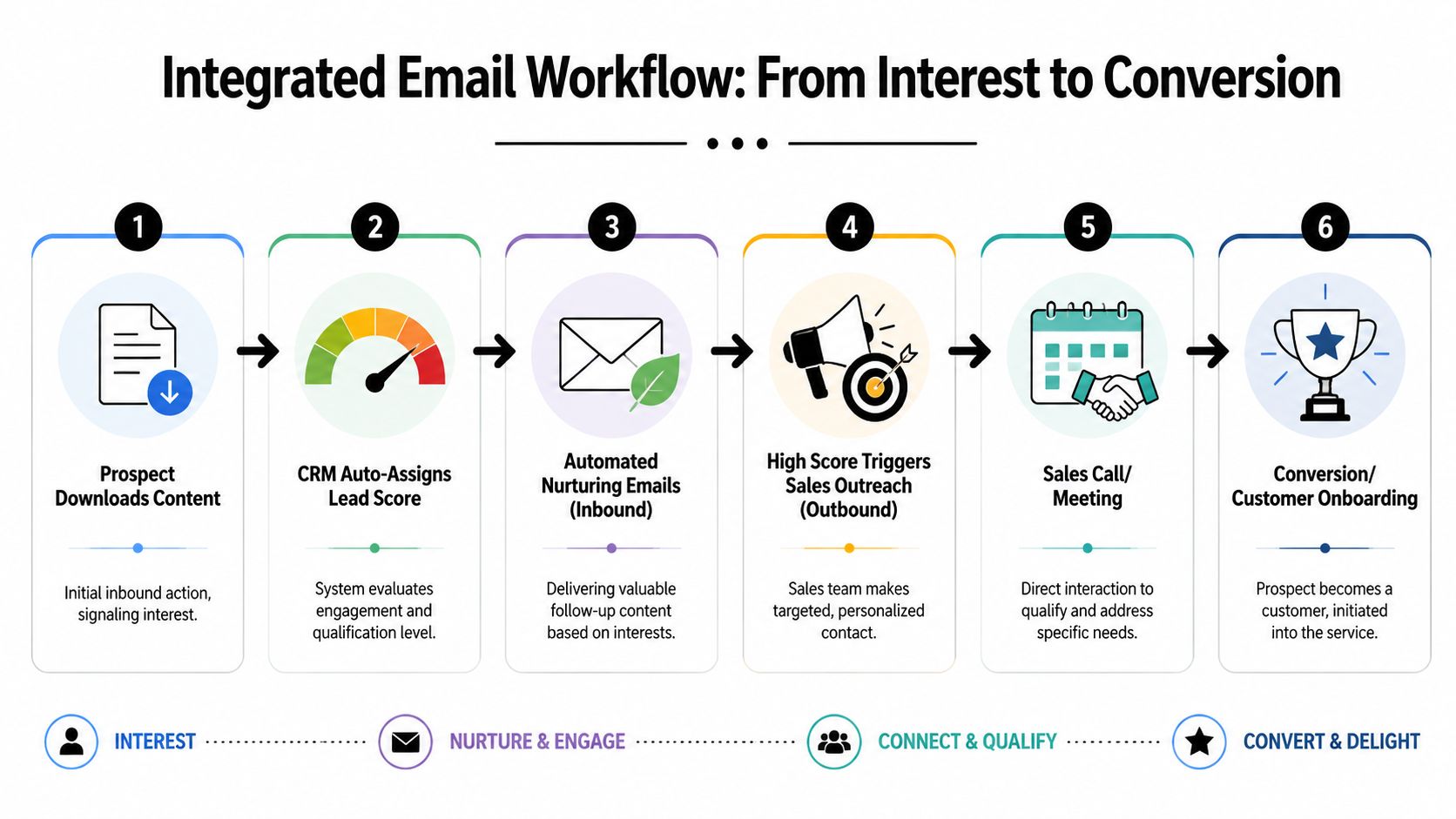
The six-step workflow
- Capture the first inbound action. A prospect downloads a guide, starts a trial, joins a waitlist, or subscribes to updates. This is the moment you identify the contact and attach a source.
- Score the lead using observable behavior. Start with practical signals such as repeat visits, high-intent page views, form submissions, or product usage milestones.
- Launch automated nurture. Send useful, behavior-linked emails. If someone downloaded a tactical guide, send implementation content. If they started a trial, send onboarding steps and feature education.
- Trigger outbound when interest becomes specific. Pricing page visits, demo-page returns, use-case engagement, or strong product activity can justify a personal email from sales or founder-led outreach.
- Move the conversation into human follow-up. Reference the actual signal, explain what similar buyers usually want to know next, and offer one clear next step.
- Route outcomes back into the system. Replies, meetings, objections, and no-response outcomes should update the CRM so future emails reflect what happened.
The SMB tech stack that supports it
You don't need a sprawling stack. You need a few systems that talk to each other reliably:
- CRM for contact records, account ownership, and lifecycle stage.
- Marketing automation for forms, nurtures, and trigger logic.
- Sales engagement or outbound sending for personalized follow-up.
- Analytics and site tracking to identify meaningful behavior.
Mailneo can fit on the email execution side for teams that want AI-supported email marketing and automation without turning setup into a long implementation project. It's one option in a stack that might also include a CRM like HubSpot or Pipedrive and form tracking through your website platform.
What the outbound email should actually say
When a signal triggers outreach, keep the structure tight:
- Reference the action the buyer took.
- Connect it to a likely need.
- Offer one next step.
- Avoid long company background.
A weak triggered outbound email says, "Wanted to see if you had questions."
A stronger one says, "You looked at our pricing and onboarding pages. Teams at your stage usually want to know setup effort and how quickly they can launch. If helpful, I can send a short breakdown or walk you through it."
That doesn't feel cold because it isn't. It's seller-initiated, but it's informed by inbound behavior.
Campaign Templates for Your Business Type
The integrated model gets easier to apply when you tie it to real buying moments. Below are three practical templates. Each starts with an inbound trigger and uses outbound email to push the next decision.
E-commerce
For online stores, the strongest signals usually come from product behavior, not content consumption alone. A basic newsletter signup is useful. A high-value cart abandonment or repeated viewing of a premium collection is more actionable.
- Trigger: A known subscriber adds products to cart, abandons checkout, then returns to the same category.
- Outbound-style action: Send a personal-feeling email from the founder, store manager, or customer care alias instead of another generic automation.
Sample snippet:
“Subject: Need help with the items in your cart? I noticed you were looking at our [product category]. If you're comparing options, I can help narrow it down based on fit, size, or intended use. Reply with what you're choosing between and I'll point you to the best match.”
This works because the email uses inbound behavior as context, but the tone is direct and conversational. It feels closer to sales-assisted commerce than standard lifecycle automation.
SaaS
SaaS teams often miss the handoff point between nurture and outreach. Trial users don't need the same treatment forever. Once product usage suggests intent, a human email should take over.
- Trigger: A user from a target company activates key features, invites teammates, or repeatedly views plan and integration pages.
- Outbound-style action: An account owner sends a short email tied to the trial behavior and likely rollout questions.
Sample snippet:
“Subject: Saw your team testing [feature] Looks like your team has been working through [feature or workflow]. When companies get to this point, the next questions are usually around rollout and internal adoption. If you'd like, I can send a simple setup path based on your use case.”
For ongoing nurture ideas that support this handoff, these lead nurturing email examples are a useful reference point.
Marketing agencies
Agencies usually sell expertise, trust, and fit. That means the strongest inbound signals often come from case study views, service-page engagement, or downloads tied to a specific problem.
- Trigger: A decision-maker downloads a case study or spends time on a service page related to a known pain point.
- Outbound-style action: Send a designed note that connects the downloaded asset to a likely business objective.
Sample snippet:
“Subject: Question on [channel or service area] You downloaded our case study on [topic]. Teams that read that piece are usually trying to fix one of two problems: inconsistent pipeline quality or weak conversion after lead capture. If either is on your list, I can share how we'd diagnose it before recommending any engagement.”
“The best trigger-based outbound emails don't sound automated. They sound observant.”
Across all three business types, the pattern holds. Inbound tells you who is leaning in. Outbound gives you a precise moment to respond like a person, not a drip sequence.
Measuring What Matters for Inbound and Outbound
Most reporting problems start when teams force both motions into the same scorecard.
Inbound and outbound should not be judged by identical criteria because they do different jobs. Outbound is usually measured on contactability, reply quality, meeting creation, and source segmentation. Inbound is better measured through conversion across the funnel, from visit to lead, lead to opportunity, and opportunity to close. That distinction follows the practical B2B guidance described earlier in the article.
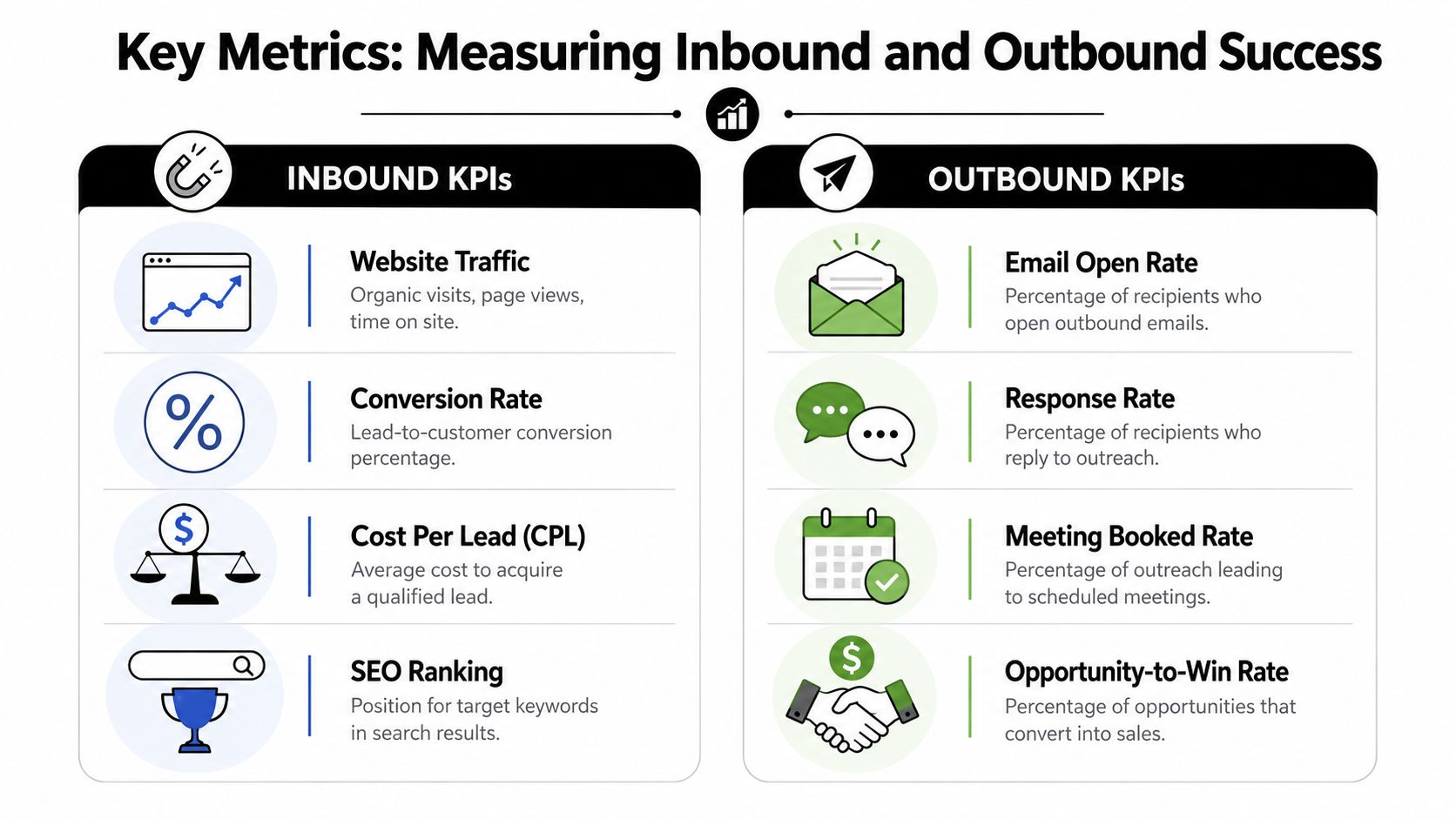
Build two views before you build one dashboard
Use a split measurement model.
| Motion | Core question |
|---|---|
| Inbound | Are the right people converting once they arrive? |
| Outbound | Are we reaching the right people with enough relevance to start conversations? |
| Integrated | Do inbound signals improve outbound timing and downstream conversion? |
For inbound, watch:
For inbound, watch:
- Visit-to-lead conversion.
- Lead-to-opportunity progression.
- Opportunity-to-close movement.
- Engagement with nurture emails.
For outbound, watch:
- Contactability.
- Reply rate.
- Meeting rate.
- Quality by segment, account type, or signal source.
Measure the handoff, not just the channels
The most overlooked layer is the transition between inbound and outbound. That's where a lot of value gets lost.
You need to know:
- How fast reps act after a high-intent signal appears.
- Which signals lead to useful conversations.
- Whether triggered outbound performs better than fully cold outbound.
- Whether warm follow-up is routed to the right owner.
A lot of vanity reporting obscures the true answer. To understand the performance gap, you have to normalize for buyer stage and attribution lag, because the winning motion isn't always the one with the lowest top-of-funnel cost. It's often the one that best matches observable intent, which can make targeted outbound much more effective for later-stage prospects, as explained in this analysis of how to compare inbound and outbound performance.
Protect measurement with deliverability discipline
Bad deliverability corrupts the whole dashboard. If your messages don't land, inbound engagement drops and outbound reply rates become misleading.
That's why teams should pair performance reporting with routine checks on sending health, list quality, authentication status inside their platforms, and engagement decay. A practical companion resource is this email deliverability guide, especially for teams that are trying to compare sequence performance without first confirming inbox placement is stable.
“Don't ask whether inbound or outbound is better until you're sure both are actually reaching the inbox and being measured at the right buyer stage.”
A useful reporting cadence is monthly for trend analysis and weekly for execution checks. Weekly tells you whether routing, sending, and follow-up are working. Monthly tells you whether the system is producing qualified pipeline.
One Engine Two Cylinders
Inbound and outbound email aren't competing systems. They're two ways to move the same buyer forward.
Inbound attracts and qualifies interest. Outbound adds precision, urgency, and human follow-up when timing matters. When you connect them, email stops being a batch-and-blast channel and starts acting like a coordinated revenue system.
If you want a practical place to start, don't rebuild everything at once. Pick one inbound signal you already have. Pricing-page visits. Trial activation. Case study downloads. Then write one outbound email that responds to that signal with relevance.
Mailneo helps SMB teams run email marketing with automation and AI support, which makes it easier to turn inbound signals into timely follow-up and structured campaigns. If you're building a unified outbound & inbound email workflow, explore Mailneo to see whether it fits your stack.
Explore: Email Marketing Strategy
Related Articles
Master B2B Appointment Setting: Playbook for Qualified Meetings
B2B appointment setting works when it operates as a revenue system, not calendar admin. This playbook covers ICP targeting, multi-channel outreach, qualification, measurement, and automation so teams can turn the right accounts into qualified conversations.
Business to Business Mailing Lists: A 2026 Guide
Business to business mailing lists are revenue datasets, not static rosters. This guide explains when to build, buy, or enrich B2B lists, how to vet vendors, and how to keep data clean, compliant, and useful for campaigns.
Pay Per Lead Marketing: A Complete Guide for 2026
Pay per lead marketing can work when the billable event, validation rules, handoff process, rejection terms, and unit economics are clearly defined. This guide explains how to manage PPL programs without paying for low-quality demand.
Email Blast vs Campaign vs Automation: What to Use
An email blast is a broad one-off send, a campaign is a planned marketing effort, and automation is a rule-based flow triggered by timing or behavior. The right choice depends on intent, segmentation, consent, and how much follow-up logic the message needs.
Ready to supercharge your email marketing?
Start sending smarter emails with AI-powered campaigns. No credit card required.
Get Started Free