Email Marketing for Agencies: How to Package and Run the Service
Email marketing works as an agency service line when it is packaged: fixed deliverables, a written onboarding sequence, automations built before campaign calendars, and reporting that connects sends to revenue. Here is the operating model, tier by tier.

Package it. Fixed deliverables, a written onboarding sequence, automations built before campaign calendars, and reporting the client can act on; plus a hard line between one-time builds and monthly management. Agencies that sell email as a loose task list bleed margin on every account, and they usually can't explain why.
Here's how the loose version fails. A client signs and says they want email marketing. Someone requests Klaviyo access, someone designs a template, someone writes three campaigns, and a month later the client asks whether email is "working." Nobody has a clean answer, because nobody agreed what an answer would look like before the work started.
The fix is unglamorous and mostly paperwork.
Pin the work to the business model
Bad email accounts usually trace back to a missing link between the sending and how the client actually makes money. The copy is rarely the problem.
Before your team writes a subject line, get answers to five things: what the business needs from email (revenue, retention, lead nurture, repeat purchase, activation, bookings); what kind of company it is, since an e-commerce catalog and a B2B services firm need different cadences and different message types; where email sits in the funnel; who owns conversion after the click, which is more often the client's site team than anyone admits at kickoff; and what already exists in the stack, meaning ESP, CRM, forms, event tracking, segments, and approval workflow.
Then audit before you promise anything. Confirm data actually passes between the ESP, the store or CRM, and site forms. Check where subscribers came from and how consent was collected, because a big list and a healthy list are different objects. Open every existing automation; half of them exist in name only, triggered but empty, or paused a year ago and never restarted. Find the brand assets, which usually live in five folders owned by three people. And ask who signs off on copy and offers, and how long that takes.
When a client says they need better emails, they usually need better decisions before the email gets built.
Say the hard part early. Some accounts need technical cleanup before any performance work; some need a stronger offer; some need a full reset. Telling the truth in week one protects delivery in month three.
Package the work into three offers
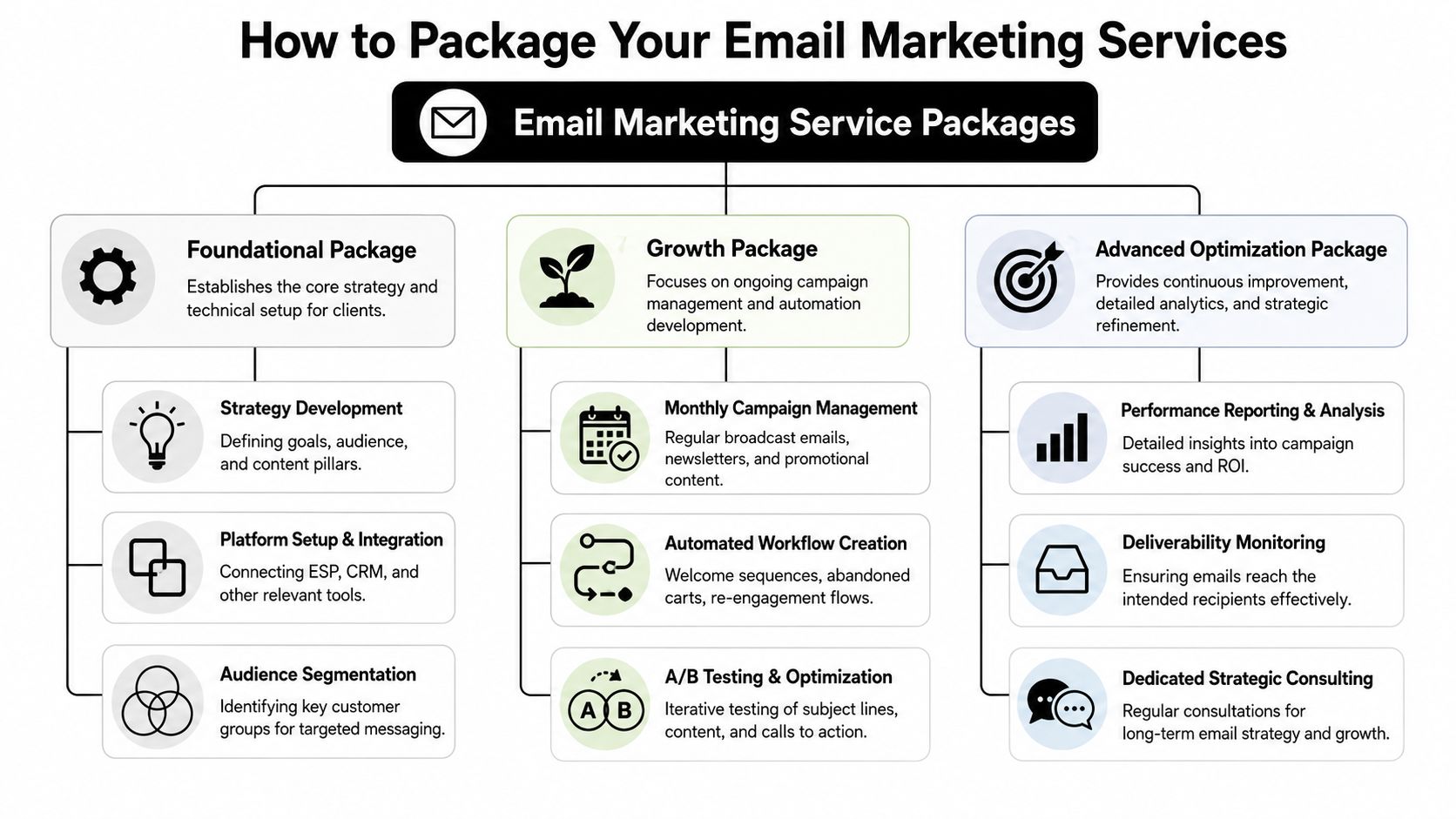
Clients buy email in three shapes: cleanup, management, and optimization. Package to match, and prospects place themselves on the sales call without you doing much work.
A Foundational package covers strategy, platform and integration review, segmentation setup, and a prioritized build plan. It's the right offer for accounts with scattered assets and no operating system.
A Growth package is the core retainer: recurring campaign production, copy and design, calendar planning, automation builds, QA, monthly reporting.
An Advanced Optimization package covers deeper analysis, deliverability oversight, testing discipline, and executive reporting. It only works on mature accounts where the basics already function; sell it to a broken account and you'll spend the retainer on cleanup you didn't quote.
Four packaging rules keep the margin alive. Separate builds from management, so a one-time flow buildout never disappears inside a monthly fee. Cap revision cycles, because unlimited revisions turn a profitable account into approval theater. Write down dependencies when the client owns design assets, offer approvals, or product feed fixes. And price complexity rather than output; two campaigns for a regulated SaaS brand can eat more hours than four promos for a simple catalog.
Clients rarely object to paying for email once they can see what's included and what happens first. They object when the service sounds improvised.
Onboarding is an access problem before it's a strategy problem
If credentials and approvals aren't locked down in week one, your team spends month one chasing permissions instead of shipping.
Get the systems first: real user roles in the ESP and CRM (never a shared password), analytics and site access so you can see forms and purchase paths, confirmation that the sending domain is authenticated and owned by the client, and documentation of how consent is collected. Our email marketing checklist works as a starting point if you're building your own intake SOP.
Then gather the production inputs. Brand system, offer calendar, editorial topics, objections from the sales and support teams, existing segments, known high-value buyers. Also the approval map: one decision-maker is ideal, three stakeholders with equal authority is how projects die.
By the end of week one, an agency onboarding should answer four questions: what can we access, what can we send, what needs approval, and what gets built first.
Build automations before you build a campaign calendar
Most client accounts I inherit are running too many broadcasts and too few flows. Broadcasts matter (launches, promotions, newsletters, seasonal pushes all need them) but they're labor-heavy. Someone briefs, writes, designs, routes for approval, QAs, and schedules each one. Build the whole service around one-off sends and you've built a production shop that starts from zero every month.
Flows are the part that keeps paying after you build it. The core set:
- A welcome series that sets expectations and moves a new subscriber toward a first purchase or first meaningful action. Welcome examples are a decent starting structure.
- Cart and browse abandonment, written around friction reduction rather than escalating discounts.
- Post-purchase sequences that reinforce the decision, cut support load, and set up the next conversion.
- Back-in-stock and price-drop alerts, which catch the highest-intent traffic you'll ever email.
- Win-back, which can name the inactivity directly instead of pretending nothing changed.
Timing does part of the persuasion for you; a browse abandonment email lands while interest is still warm. Map each flow before building it (trigger, suppression logic, exit conditions, content sequence, goal), then walk the whole path including rendering, links, and timing windows. Plenty of underperforming automations are setup failures wearing a strategy costume. For reference architectures, our e-commerce flow maps and SaaS flow maps lay out the sequences and triggers.
The shift that separates good agency accounts from mediocre ones is when the weekly question stops being "what should we send?" and becomes "what should happen automatically when a customer does this?"
Segment on behavior, then actually change the message
Generic email isn't harmless. It burns attention and trains subscribers to skip the sender.
Useful segments come from actions the customer already took: recent buyers who need onboarding or replenishment timing, repeat customers who respond to access and early looks, inactive subscribers who need re-permission, high-intent non-buyers who viewed products repeatedly without converting, and (for B2B and SaaS) lead-source segments, because webinar leads and trial users behave nothing alike. Our segmentation guide goes deeper on the model.
Here's where agencies plateau. They build the segments, then send everyone the same email. The database changed; the message didn't.
Personalization past the first-name token means using category interest, purchase context, product knowledge level, and known objections. A trial user needs friction removed. A VIP wants access more than education. A first-time buyer wants proof.
Then test angles rather than button colors. An angle is the reason to care: convenience, cost, status, risk reduction, speed to value, outcome, confidence. Lapsed customers often respond better to a low-friction way back in than to a bigger discount. A lead from a comparison page needs differentiation. Run the angle against a real segment before you scale the copy behind it; that discipline is also the easiest thing to explain in a QBR, because it shows your team validates positioning rather than producing emails.
Reporting that defends the retainer
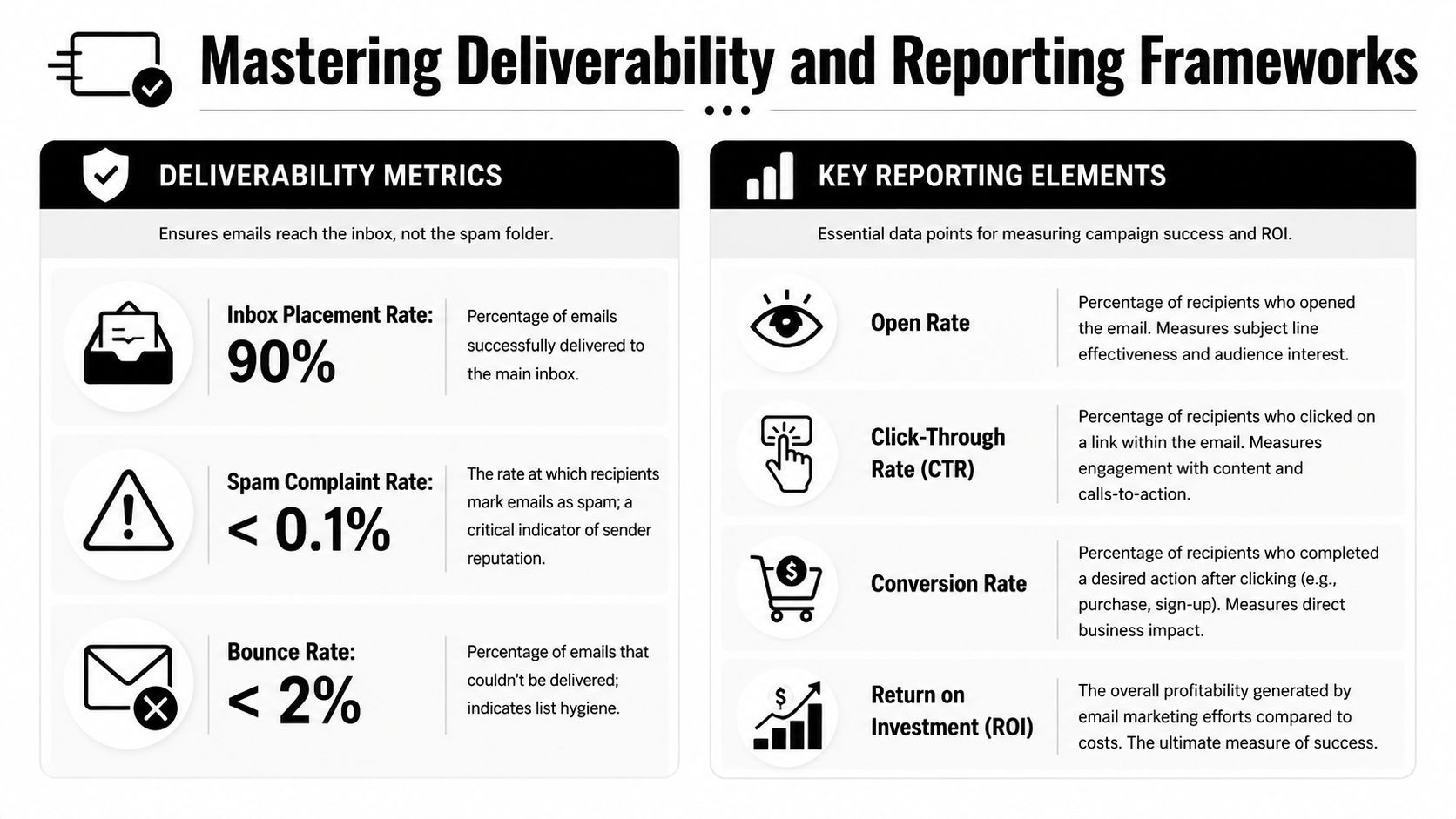
Clients don't renew because a dashboard looks busy. They renew when the report connects work to money.
| Reporting layer | What to show | Why it matters |
|---|---|---|
| Operational | Sends, segments used, automations built, QA issues caught | Proves the work happened |
| Performance | Click rate, conversion rate, revenue per email, list growth, engagement trend | Shows whether the program is healthy |
| Strategic | What changed, what you learned, what gets adjusted next | Shows judgment rather than output |
Lead with what improved, what underperformed, which segment needs a different message, which automation needs a rebuild, and what the next test is. If you want context for the numbers, industry benchmarks are fine as background; they're a terrible target, since your client's list quality moves results far more than their vertical does.
Watch two numbers as early-warning signals every month: unsubscribe rate and spam complaint rate. Both usually spike before revenue does, and both point at acquisition source or send frequency rather than copy. Authentication, list hygiene, and a real suppression list are table stakes on every account you take over; when inbox placement genuinely degrades, work the deliverability guide rather than rewriting subject lines.
Reporting also protects scope. Tie results to the systems you built and segmentation work reads as valuable; skip that narrative and the client quietly reclassifies your retainer as "sending newsletters," which makes every invoice harder to defend.
Price the model, then use AI on the cheap parts
Agencies undercut themselves by quoting against a competitor's price or the client's stated budget, then discovering the account needs three months of cleanup nobody scoped.
| Model | Best for | Watch out for |
|---|---|---|
| Flat monthly retainer | Ongoing campaign management and steady optimization | Hides scope creep unless deliverables are tightly defined |
| One-time project fee | Audits, migrations, setup, automation buildouts | No recurring revenue unless you upsell management |
| Hybrid retainer plus projects | Accounts needing steady support and periodic builds | Requires real proposal discipline |
| Performance-based hybrid | Mature accounts with clean tracking and mutual trust | Ugly when attribution is messy or other channels influence conversion |
Hybrid is the realistic answer for most agencies, because most clients need both. The rule underneath all four models: never bury cleanup inside a standard monthly package. Platform reorganization, flow rebuilds, segmentation overhauls, and list recovery each deserve a line item.
AI earns its place in the narrow parts of the workflow. First-pass copy variants, summarizing performance patterns across campaigns, generating segment-specific versions for a strategist to edit, drafting content calendars off a launch schedule, flagging list-quality problems. What it should not do is decide brand voice, invent customer insight, or publish lifecycle logic nobody reviewed. It compresses production time; your team still decides which message belongs to which segment and why. Our take on where this is heading is in the future of AI email marketing.
The agencies that scale this service line don't automate the craft. They standardize the process, protect the strategy work, and let software eat the low-value hours.
If you want a simpler way to run client email programs without adding manual work, Mailneo is built for AI-assisted email marketing that stays focused on execution.
How many campaigns should an agency send per month?
It depends on list quality, audience expectation, and the offer calendar. A small engaged list often does better with fewer, tighter segments; an e-commerce client with a constant launch cadence can support weekly or more. Set the number from complaint and unsubscribe trends rather than from a template.
Explore: Email Marketing Strategy
Related Articles
The best email marketing tools in 2026 (compared)
The best email marketing tools in 2026 split cleanly by use case: MailerLite and Mailchimp for small teams, Klaviyo for ecommerce, ActiveCampaign for B2B automation, SendGrid or Postmark for transactional, and Mailneo for outbound plus lifecycle in one workspace.
Email Marketing Automation: From Basics to Advanced
Email marketing automation sends targeted messages triggered by subscriber actions or time rules, without manual sending. This guide walks through triggers, workflows, benchmarks, and advanced tactics (with real Mailneo data) so you can build sequences that drive revenue and retention.
Fix Email Deliverability Issues: Your 2026 Guide
Email deliverability issues are usually a stack of authentication, sender reputation, engagement, list quality, and sending-pattern problems. This guide gives teams a diagnostic workflow for finding the real cause before changing copy or platforms.
Email Marketing Metrics: The 2026 Guide
Six numbers run an email program: open rate, click-through rate, click-to-open rate, bounce rate, unsubscribes and complaints, and conversion with revenue per email behind it. Here is what each one diagnoses, in the order they break.
Ready to supercharge your email marketing?
Start sending smarter emails with AI-powered campaigns. No credit card required.
Get Started Free